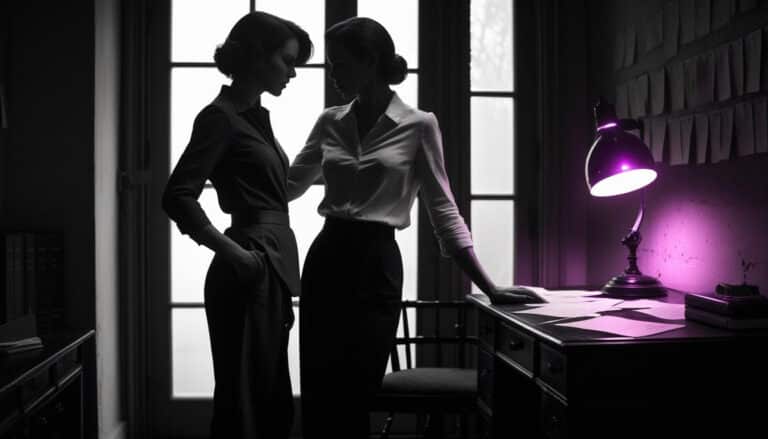
Chief Takes Charge of the Specialist
The conservatory held its breath the way a throat does before a name.
Ava had come for the scrubber-root nearest the inner bulkhead, or so the log would later claim. In truth she had come because the storm had sealed the outer decks and this gallery was the only fully shielded interior, and because she had learned the station by looking at what other people did with their hands. Six months aboard and she still mapped Willa more carefully than she mapped the flora.
At the far airlock, the hatch dilated.
Willa entered as she always entered: precise, almost ceremonially upright even in the sixth-gravity drift, as if posture itself were a hull integrity check. The pollen-light—that slow gold the hanging systems exhaled, more dust than illumination—caught on the dark of her hair, cut blunt at the jaw so that it lifted and settled with each drift like something breathing, and on the pale of her throat, and then, farther down, on the thing Ava had catalogued for months and never mentioned.
When Willa believed herself unobserved, her left hand found the cuff of her sleeve and folded it, unfolded it, folded it again.
A small, private restlessness. The only leak in an otherwise sealed person.
Ava watched the thumb worry the seam. She did not look away.
The gallery ran the station’s spine: one long nave of living architecture, root-systems suspended like inverted forests, their pale cords doubling as air-scrubbers, seed-pods hanging among them the colour of old bone. If struck they chimed, a thin mineral note the biome recorded as stress. Outside, beyond the shielded glass, the violet ice giant turned its rings through the storm; ice ticked faintly against the outer hull, a sound like someone counting under their breath. Recyclers whispered at the edge of hearing. Nothing else. The station had gone quiet the way animals go quiet.
Willa’s hand stilled. She had seen Ava, or felt herself seen. The cuff was left half-folded, a tiny failure of ceremony. Distance made a kind of privacy of them still: twenty metres of hanging garden, of pollen that would eddy if anyone moved too fast, of roots that bruised and wept a clear sap if struck. They could not walk. They could only choose.
Willa’s voice crossed the length of it first, not raised, only aimed.
“Specialist.”
Ava’s mouth found the old register as if it were a handhold.
“Chief.”
Nothing else, for a moment. The titles hung between them like a third presence, useful, load-bearing, the way Willa kept the hull from leaking. Ava’s fingers were still on the scrubber-root, feeling the slow pulse of water through cellulose, the plant’s indifferent work. She had meant to look busy. She had meant, as always, not to be the one who asked.
Then her boot lost the root-hold.
It was a small stupidity, the kind the sixth-gravity made theatrical. The sole slipped; the body, which had been pretending at weight, remembered it had almost none. Ava drifted. Slow, humiliating, a pale rotation of limb and braid and the open shame of being suddenly unmoored in front of the one person whose composure she had spent half a year studying like a second taxonomy. Her shoulder brushed a hanging cord. The root gave a little, elastic, and did not chime, but the pollen-light stirred in a dangerous eddy, gold thickening into visible weather.
She caught nothing. There was, for three long heartbeats, nothing to catch.
Willa’s voice, when it came, was not louder. It was only different.
“Ava.”
The given name, used once, on purpose, in the quiet.
The title did not return.
Ava’s drift slowed against another root, her palm finding it by accident, by the body’s older intelligence. The name went through her the way light goes through water: not a blow, a medium. She had heard her own name a thousand times in other mouths. She had never heard it in this one. Willa said it and did not take it back. The barrier did not survive it. Something that had been hull became, simply, air.
They looked at each other along the nave of the garden.
Willa started toward her.
Ava started toward Willa.
To close the distance they could not walk. Gravity would not allow haste; the hanging roots bruised and wept if struck; sudden movement sent the pollen-light into those dangerous eddies that the storm-protocol forbade, the biome treating turbulence as a kind of wound. They had to push off, drift, catch, wait. Each metre was a negotiation with living architecture.
Willa pushed first from the airlock frame, a controlled vector, knees slightly bent, the body remembering every posting where a wrong angle had meant a bruise or a breach. She came like a thought one has decided, at last, to think. Ava watched her hands the whole way. The left one no longer folded the cuff. It was open, slightly, as if it had forgotten its private work and not yet learned another.
Ava pushed from her root. Too much force and she would tumble; too little and she would hang, ridiculous, in the gold. She chose little. The garden received her the way water receives a dropped stone that has almost no weight: a slow concentric giving. A seed-pod turned as she passed, did not chime. She exhaled through her teeth, a sound too small for the recyclers to claim.
Halfway, a thick cord of scrubber-root barred the lane. Willa reached it first, caught it with both hands, waited. The waiting was not stillness; in this gravity stillness was only a slower form of falling. Her hair lifted in a dark corona. The pollen settled on her sleeve, on the half-folded cuff, a constellation of gold that would have to be brushed away later with the same care the garden required now. She did not look at Ava’s face. She looked at Ava’s hands, as if hands were the honest part.
Ava drifted into range of the same cord. Not touching yet. A metre of scented air, mineral and green, the faint iron of sap where some earlier negligence had already bruised the living. She could see the pulse at Willa’s throat. She could see, because she had trained herself to see, that Willa’s jaw was not quite set. A flex, almost nothing. The same leak as the cuff, translated upward.
Willa said nothing more. She only moved her left hand a fraction along the cord, toward Ava, and stopped, as if the root itself might carry what a name had carried.
Ava’s left hand found the cord a hand’s width from Willa’s. The cellulose was cool, faintly ridged, wet with the gallery’s perpetual mist. She did not close the width. Closing it would be a decision the garden would notice, would record as pressure, as weather. She let her body finish its drift until the two of them hung there, facing each other along the cord, a shared equator, their boots nowhere, their hair independent of gravity’s old argument.
They watched each other’s hands.
Willa’s right hand left the root. Slowly—there was no other speed the room would permit—it travelled the pale distance. Not reaching for Ava’s face, not yet, nothing so ungoverned. Reaching for the interval. Permission, pause, the care of a hand that knows what a startled root will do. Ava understood, with the interior clarity that had always been her only rank, that every careful drift had already been a touching, that the name had only spoken aloud what the slowness had been saying for months.
Ava’s right hand rose to meet it, the left keeping the cord for both of them.
The approach of two palms, in one-sixth gravity, is an event with duration. Skin knows it before mind does: the warming of the gap, the almost-scent of the other person’s wrist, salt and station soap and the ghost of recycled air that has been through another set of lungs. Ava’s pulse was a loud, private thing. She thought of the shared shifts, shared silence, never an unguarded sentence. She thought of titles used like bulkheads. She thought, without meaning to, of the thumb on the seam of the cuff, that small restlessness she had kept like a secret specimen.
Their fingers found each other.
Not a clasp. A negotiation. Fingertips first, the pads, the shy intelligence of nerve endings that had lived under uniform since the docking. Then the slow interlocking that low gravity makes ceremonial, because nothing can be grabbed, because grabbing would send them both into a spin, into the pods, into the chime the biome would take as injury. They stayed inside the slowness as inside a climate.
Willa’s hand was warmer than Ava had allowed herself to imagine. It was also, finally, still. No folding. No seam. Simply there, in Ava’s, a fact the gallery’s pollen-light gilded as if the light too had been waiting.
They hung in the middle of the nave, a single slow organism of two, the hanging roots around them like an audience that had taken a vow of quiet. Outside, the storm wrote itself across the rings in violet. Inside, the recyclers kept their almost-inaudible faith. Ava could see the colour of Willa’s eyes at this distance, could see the decision not yet spoken moving behind them, opaque as ever, a weather she could watch and not enter. She could see Willa’s mouth.
Their fingers loosened, a fraction, as if to let the joining breathe, and Ava’s thumb, traitor to months of unwillingness, moved once across the inside of Willa’s wrist, where the pulse was, where a clasp of station knit would later have to be learned by fingers, by patience, by the same law that had brought them here inch by drifting inch.
Willa did not pull away.
She did not speak.
She only looked at Ava’s mouth in return, and the garden, which would not let them lunge, which would not let them skip the minutes, held them there at the absolute edge of the possible—two women hung in gold, hands already a kind of vow, the rest of the distance not yet crossed, and every seed-pod waiting, unstruck, for whatever sound they were about to be careful enough to make.
It was Willa who closed it.
Her left hand walked the cord a finger’s width, and another, the way one walks a rope in the dark, and the root took her weight—what little there was of it—and flexed, and breathed, and did not chime. Their joined hands folded inward between them, elbows giving, the interval collapsing by increments so small the pollen registered nothing. Half a metre became a hand. A hand became a breath. Ava kept the cord in her left fist and did not move toward the last of it; she let it be brought to her, watched it come, the small vector of a chin inclining, Willa’s eyes open the whole way.
Willa’s mouth found hers the way a hand finds a hold it has already measured: without haste, without the violence of certainty.
The first contact was only that—lip to lip, a pressure so slight the pollen-light did not stir. Ava felt it as temperature before she felt it as meaning, a warmth arriving through the last thin weather of air. She did not close her eyes. Months of looking had made looking a kind of loyalty; to look away now would have been a small desertion. Willa’s lashes were gold-dusted. Close, the opacity of her did not lessen. It only grew more finely grained, a mystery with pores, with the faint salt-line where the station’s dry air had touched the corner of her mouth and left it.
They hung.
The garden would not permit a kiss to be a doorway, and so the kiss became the room they entered, and they stayed in it the way one stays in a climate that has taken a long time to trust. Ava’s mouth learned the shape of Willa’s in increments: the upper lip first, then the slight give of the lower, then the slow permission of breath exchanging itself, recycled already by the hanging roots and now recycled again between them, intimate as a shared lung. A seed-pod turned half a degree on its stem and did not speak. Ice ticked against the hull, counting for them.
Willa’s left hand—the restless one—left the cord. Ava felt the whole small weight of them come into her own fist, the cellulose flexing, a root’s patient answer, and she held. Willa’s hand rose as if through water. It found Ava’s face and moved across it slowly, a cartographer’s hand rather than a lover’s, or a lover’s learning to be a cartographer’s: fingertips along the cheekbone, the temple, the small weather of hair at the hairline where the braid had loosened in the drift. Ava felt herself being read. She had mapped Willa by cuffs and silences; now she was the specimen, held in a patience that made her throat ache. The hand travelled into her hair with a care the roots would have recognised: no pulling, only the slow unbraiding of what gravity had already begun to undo, dark strands lifting, gold catching, all of her becoming ungoverned in Willa’s palm.
Ava’s right hand, still joined to Willa’s, tightened once—the smallest pressure, a question—and then left that first vow to find the line of a shoulder. Station knit, warm from the body, the seam a ridge her thumb followed as it had once followed the pulse at the wrist. The shoulder was narrower than the uniform had argued. Under the fabric, bone and the long discipline of a decade of postings. Ava learned it the way she learned a new leaf: by not hurrying the knowing.
Their bodies arrived by slow degrees.
A knee found a knee. Hip to hip through the pale gold weather, a contact so gradual it had the quality of light changing rather than of flesh deciding. Willa’s boot found a lower loop of the same root and hooked there, the habit of a body that had never trusted a drift it could not correct, and the two of them became a small moored system, held at two points, the cord between. Ava’s chest met Willa’s with a softness that made her inhale too sharply; the sound was only breath, but in the conservatory’s quiet it felt loud as a chime. She stilled. Willa stilled with her. A pod hung an arm’s length away, bone-coloured, listening. When the air had forgiven them, Willa’s mouth opened against hers a fraction more, and the kiss deepened the way dusk deepens—not a fall, a thickening.
Wet quiet. The small catch of lip. Ava tasted station tea, the mineral ghost of recycled water, something underneath that was only Willa and had no analogue in the flora. She thought, dimly, of all the unguarded sentences they had never spoken, and felt them arriving now as this instead: as tongue, as the slow slide of it, as Willa’s breath fracturing once against her upper lip and being gathered back into composure that was no longer quite composure. Ava’s hand left the shoulder and found the nape, the short dark hair there, the heat. Willa made a sound that wanted to be official and failed. A broken inhale, caught, offered to no log.
The kissing went on.
It went on until Ava’s mouth felt bruised with gentleness, until her sense of up had dissolved entirely into the axis of Willa’s face, until the months of watching the thumb on the seam had nowhere left to live except in this: in being touched, at last, by the hand that had done the folding. Willa’s palm at her jaw. Willa’s mouth at the corner of hers, then the centre, then—slow as a root seeking water—the hinge just below the ear, a place so unused it seemed to Ava she had not known she possessed it. Her whole body became a slow instrument. The garden’s mist beaded in her hair. She was shaking already, a fine tremor the sixth-gravity made visible, her limbs describing small helpless orbits against the moored length of Willa’s body, and Willa’s boot in its loop of root taking the tremor, and the root taking it from her, and giving it back to the air as nothing.
When Willa’s mouth returned to hers, Ava understood that undressing would have to happen inside the same law. Nothing here could be taken—not a garment, not a name, not the skin that had been uniform-covered since the docking, since the first day Willa had said Specialist and looked through her as if looking through a viewport that showed only systems.
Ava’s fingers found the magnetic clasp at Willa’s collar.
She did not open it. She learned it. The small cold geometry, the give of it under a pad of thumb, the way it wanted to release and would, if asked correctly, without a sound. Willa’s pulse moved under the knit. Ava waited. Willa’s hand covered hers on the clasp—not to stop it, to accompany it—and together they asked. The magnet let go with a hush too soft for the recyclers. The collar eased. The two edges of knit parted a finger’s width at the throat, the garment still worn, only opened, the hollow of Willa’s throat showing pale in the gap like something seen through a door left ajar.
Mouth at the collarbone, then. That was the sequence the room had taught them: fingers first, then the mouth, as if the mouth were only a slower finger. Ava’s lips found the ridge of bone, the skin there startling in its temperature, its aliveness, six months of looking transmuted into this one square of salt and heat. Willa’s broken inhale happened against the crown of Ava’s hair. Ava felt it more than heard it. She paused. A seed-pod, disturbed by the eddy of their breath, trembled on its cord. They waited, mouths still, until the pod thought better of chiming. The biome’s silence held. Ice ticked. They went on.
Willa’s hands at Ava’s clasps were more precise, and somehow more undone for being precise. Wrist first—the right cuff, the free hand, the one Ava had never in her life thought about until now; the left she could not give, because the left was the cord, was the whole small weight of them. Willa opened the clasp as if defusing something. The magnet yielded. She lifted Ava’s right wrist to her mouth and stayed there, not kissing so much as breathing against the newly bared skin, the pale map of veins, the place a watch would have lived on another kind of world. Ava’s sound was the almost-inaudible catch the conservatory could just bear: a small wet sound in the throat, name-shaped, not yet a name.
Then the collar. Then the line of clasps down the front of the knit, one after another, each with its small hush, Willa’s fingers pausing between them the way one pauses between the beads of something counted. The knit opened along Ava’s sternum and did not fall. It hung on her the way the pollen hung, undecided. To take it from her shoulders Ava would have to let go of the cord, and so the swap was made without a word: Willa’s left hand returned to the root above Ava’s fist, took it, and only then did Ava’s fingers uncurl. For a moment she was held by nothing but Willa’s boot in its loop and Willa’s hand on the cellulose and the slow gold air. Willa drew the knit back from one shoulder, then the other, and Ava gave her arms to it one at a time, the sleeves peeling with a patience that made her want to weep, the still-clasped left cuff the last of it to let her go, until the garment came free entire and turned once between them and drifted, an arm’s length off, the one pale flag she had let go of.
Beneath it, a singlet. Willa’s hands found the hem of it and gathered, and the cloth rose by centimetres, and Ava’s midriff when it appeared did so like a moon coming out from weather. Willa’s palm found the skin there and went still—finally, simply there—and Ava had to close her eyes after all, because a still hand on a place that had been covered since before she learned this woman’s restlessness was a thing the eyes could not be trusted with. The singlet had to go over her head. It was an awkwardness the garden made almost holy: Ava bowing into the cloth as into water, the braid catching, Willa’s fingers freeing it strand by strand, the two of them very careful of the pod an arm’s length off, Ava’s face emerging flushed and gold-dusted and unable, for a moment, to look anywhere. Her left hand found the cord again beneath Willa’s. The singlet turned away into the light, slow as thought.
They drifted together more closely. Shoulder to bared shoulder. Ava’s breast when Willa’s mouth arrived at it was a discovery conducted at the speed of sap, a learning rather than a hunger, nothing that would startle the air. The nipple gathered in the cool, then in the heat of a mouth that had spent a career being official. Ava’s free hand in Willa’s hair. The pollen thickening, resettling, a gold climate of their making.
When she could, Ava took her hand from that dark hair and brought it down to Willa’s front, to the clasps still fastened below the opened collar, and opened them herself. One. Willa’s breath. Another. The knit parting over the sternum, the ribs, the flat of the stomach. Willa’s right hand helped her: eased the cloth back from the right shoulder, gave the arm, let the sleeve be drawn down and off. The left sleeve stayed. Willa’s left hand was on the cord and would not leave it, and so the garment hung from that one arm, cuff open, trailing behind her in the drift like a wing she had decided to keep, as if the knit itself would not release the hand that had worried it for so long. Her body came out of the cloth like weather clearing—the older body, the precise body, kept upright through a decade of postings and never once, Ava would have wagered, undressed in a room that watched.
Ava let go of the cord and let herself sink along Willa’s length, her right hand travelling down Willa’s side as a rail, her left finding the root again lower, where it thickened, so that when her descent stopped her mouth was level with Willa’s ribs. A scar there, thin as a hairline fracture in ceramic. Ava’s mouth found it because her mouth had nowhere else it could bear to be. Willa’s control frayed as sound: that inhale again, broken, the attempt to order it into something like a systems-check, the failure of the attempt. Ava felt the failure against her lips and something in her that had only ever watched gave way, all at once, the way a root gives when it has been holding a weight too long, and she found her own thighs shaking inside the trousers she still wore, the cost of the months arriving early and uninvited in the body’s least official places.
What remained was the slow work below the waist, and the garden made them do it slowly.
Boots first. Ava, anchored by her left hand, opened the ankle clasps of Willa’s free boot and drew it from her—a strange intimacy, the heel coming out of the leather, the sock beneath, the foot with its own pulse—and let it turn away into the gold. Then Willa had to unhook the other from its loop of root, and for a moment she was held by her left hand alone, the knit trailing from that arm, while Ava eased the second boot off and sent it after the first. Station trousers were made for bodies a medic might need to reach in a hurry: a clasp at the waist and a line of magnets down each outer seam. Ava asked them open one by one. The cloth parted along Willa’s hip, her thigh, the pale skin showing in a long slow line as if a viewport were being unshuttered. Willa drew her knees up, folding at the hip the way one folds in the drift, and Ava peeled the fabric down and over and off, one leg, then the other, Willa’s right hand helping at the last, the trousers leaving her with a reluctance that seemed almost their own.
Then Willa’s turn, and Ava’s boots, and the small hushes of her own outer seams opening under Willa’s fingers—Willa working one-handed now, the left fist still married to the root, the right alone doing what a hand does when it has finally been given something better to do than a cuff—while Ava held the cord and lifted her knees and could not stop watching Willa’s face bent to the work: the concentration in it, the jaw not set, the thing that had been a leak now simply a way of being. It took minutes. The ice counted every one. When the last of the cloth left Ava’s ankle she felt the cool of the mist along the whole of her at once and made a sound the pod an arm’s length away seemed to consider, and let pass.
Clothes hung around them like a small archipelago: two pairs of boots turning at different rates, two pairs of trousers slowly unfolding their emptied legs, the singlet, Ava’s knit rotating past her knee slow as thought. Willa’s knit still hung from her left arm, one sleeve, the cuff undone. Everything else was skin and gold and the garden a third party to every inch of it. When Willa’s thigh slotted against hers it was with the same ethics as the first approaching palm—and then it went further than ethics, the long muscle of it hooking behind Ava’s own, the calf closing at the back of her knee, Willa mooring herself to Ava’s body the way she had moored herself all her life to loops of root, because there was nothing else in reach and because, for once, she did not want anything else in reach. Ava gasped into the hollow of Willa’s throat, and then lifted her face from it, and said into the small space between their mouths, once, the name she had never been invited to use:
“Willa.”
Willa’s eyes, close, changed. A wetness, or the gold catching in them; Ava could not tell which, and would not have asked. Willa did not bring her mouth back to Ava’s. She kept her face where Ava could see it, a hand’s width away, no closer, the eyes level, as if she understood that being watched was the thing Ava needed and had decided, for once, to permit it. Her right hand came to Ava’s hip and closed there, not gently, the fingers spreading over the bone, drawing the two of them flush and holding them so—the only grip in the whole slow hour that was truly a grip, the hand that would take whatever the other hand gave back, so that nothing of it would be lost to the air. And then her left hand—the cuff-hand, the restless intelligence that had been the only leak, the sleeve still trailing from the arm—let go of the root at last and travelled down between them and came to rest against Ava’s sex. Simply there. No folding. No seam. Then the heel of the palm settled, the smallest pressure, and began a movement so slight the pollen did not know it as movement, Willa’s thigh tightening behind Ava’s, the hand at her hip answering every pressure with its equal and opposite, the two of them a closed system in which nothing escaped.
Ava came the way a held note breaks.
Not climbed to; arrived at, as a tone arrives at the limit of a breath and simply cannot continue as itself. The long kissing had already tuned her past her register; the still hand that had finally stopped its private work and chosen her instead, the face a hand’s width off and not looking away, the tenderness accumulated past bearing—it broke, and the breaking was quiet, and went on. She shook in the drift, soundless except for breath, her eyes open because she needed the mystery of Willa’s face even now, especially now, the opacity she could watch and never enter. Her left fist on the cord took the whole of it and gave it to the root, and the root gave it to the air. Pleasure moved through her in slow rings, the way the gallery’s mist gathers on a leaf and lets go. She thought, helplessly, of the boot losing the root-hold, of the humiliation of being unmoored, and understood that she had been unmoored since the hatch dilated. This was only the admission. Afterward the shaking would not stop. Gold light on Willa’s mouth. The ice ticking. Ava watched and did not know, could not know, what Willa saw, seeing her like this: undone, drifting, given.
Willa said, into the hand’s width between them, once: “Ava.”
Her left hand rose from between them, wet, and found the root again above Ava’s fist, and held; the right stayed at Ava’s hip, the thigh stayed hooked, as if having learned this new mooring she would not now unlearn it. Ava’s hand, when it had learned again how to be a hand, left Willa’s hip and went down. It was not a skilled hand. It was a hand that had spent half a year cataloguing another woman’s cuff, and it moved the way it had always moved toward Willa, by increments, by asking. Willa’s thigh opened against hers a little, a permission the garden could not have recorded. Ava’s fingers found the heat of her and stayed, and pressed, and moved in the smallest arcs the room allowed, and the ice counted, and counted, and the pollen resettled around them twice, and Willa’s forehead came down at last to rest against Ava’s temple, so that Ava no longer saw her face but felt the breath of it, official, then less so, then not at all.
It arrived in Willa without announcement. A stilling first, as if the whole system had paused to check itself. Then the ceremonially upright length of her gave up its posture for the space of a few breaths—the forehead dropping to Ava’s shoulder, the hand on the cord flexing once and holding, the hand on Ava’s hip going from grip to something more like a plea, the body that had never in Ava’s sight been undefended going briefly, terribly so. No sound. Ava knew it only by what it did to the body against hers. She held her through it with hands that would not stop trembling and felt the mystery continue even here, even in this, Willa opaque at the point of vanishing, a sealed person whose only leak had been a cuff and was now this: breath in Ava’s hair, the faint wet of a mouth that had tried to stay closed and could not. Ava’s throat shut. Her eyes stung, absurdly, as if she had lost something rather than been given it. The months. All of them. Paid at once in a nave of hanging roots while a storm wrote violet across the rings and no one on the shielded decks could reach them.
They did not sleep. The room was too watchful, and so were they.
The pollen-light resettled, gold going even, the dangerous eddies forgetting themselves. Ava’s knit, the flag she had let go of, rotated slowly between them, turning, showing its inner seam, its magnetic ghosts. Ava’s hands would not be still. She hid them, at last, in Willa’s open sleeve, the one still worn, the same cuff she had watched from across the room, the thumb’s old workplace, the private restlessness now a pocket for her shaking. The cloth was warm. It smelled of Willa and of the gallery’s green mineral air. She closed her fingers in it as if it might drift away if not held, though in this gravity nothing fell; it only waited.
Willa’s formality tried to climb back into her mouth. Ava felt the attempt in the set of the jaw against her temple, the old bulkhead looking for its architecture. A title moved there, unsaid, and could not quite manage to be born. The hull, for this hour, would have to leak.
Willa said Ava’s name again, experimentally, as if checking whether the airlock would alarm.
“Ava.”
A long silence.
The recyclers whispered. A seed-pod hung unstruck. Outside, ice continued its faint arithmetic against the shielded glass.
Then Willa laughed once—small, incredulous, almost angry at herself—a sound so uncatalogued in Ava’s six-month taxonomy that it went through her like a second name. Something like recognition was in it: a seal that had failed, and in failing, held.
She helped Ava catch the floating clothes.
Dressing with the same maddening care the garden had required: the singlet drawn back down over Ava’s head, her braid caught and freed again; two pairs of trousers gathered out of their slow orbits and eased up each leg in turn while the other of them held the cord; boots found, one and one and one and one, heels seated, ankle clasps asked shut; each magnet returned to its counterpart with a little hush, Ava’s knit lifted from its rotation and given back to the body it had left, Willa’s right arm given back to the sleeve that had waited for it, the wrists last. Willa folded Ava’s right cuff once—not the old restlessness, a different ceremony—over her still-trembling pulse. Their hands, fastening each other, were not gentle so much as careful, the care of people who have just watched something break and are not yet sure what it was. Two women in the spine of a silent station, pollen in their hair, the cost of looking and not asking paid and not yet understood, the titles somewhere in the gold air like a third presence waiting to be useful again and not yet needed.
Ava’s boot found a root, lightly. She did not drift. Willa’s hand, open, remained at the small of her back, a vector, a choosing. Neither of them suggested the airlock. Beyond the glass the coronal storm was still writing itself across the rings of the violet ice giant, ice and light and the long patience of weather that had sealed every outer deck. The gallery held its breath. They held theirs with it, dressed, close, the name still usable, the cuff no longer a secret, and the seed-pods waiting, as they had waited from the first, for whatever sound the two of them would be careful enough, when the storm ended, to make.