Flood Survivors Share a Narrow Guesthouse Bed
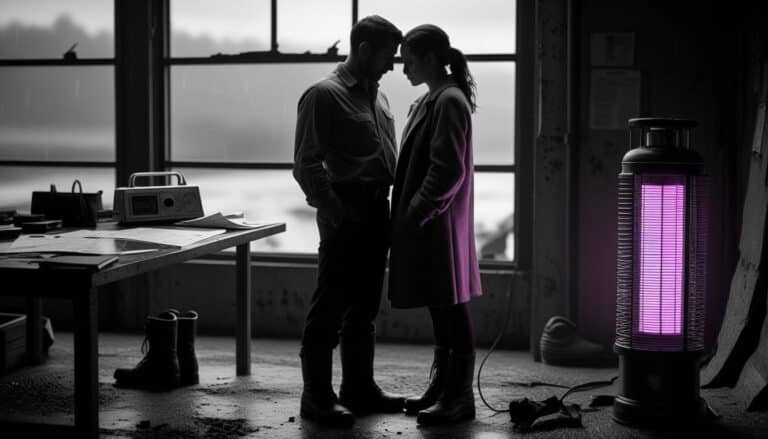
The annex corridor smelled of plaster that had been wet and of paper that had decided, narrowly, not to be. Sandra took it because the front desk meant the book, and the book meant Val’s pen, and Val’s pen had spent three weeks arranging eleven hours into a shape that could be blamed on someone. The copies in her folder knocked once against her wrist. She had brought copies. Originals made a kind of claim.
The records-room door had not quite shut. It had the look of a door abandoned by a sentence.
Reed’s voice was on the other side of it, low, unperformed. She knew that register from a dark that had had edges only because she had given them to it. She stopped.
“The report shouldn’t say I kept anyone calm.”
Val did not fill the pause. A chair answered instead, a small professional shift, the sound of a tired woman letting a witness continue.
“She was counting,” he said. “I was the one being kept.”
Sandra’s thumb found the edge of the folder and stayed there. Through the gap she could see a slice of Val’s coat, county-issue, and the line of Reed’s shoulder, turned half away from the door as if the sentence were not for a room at all.
Then, lower, the way a person speaks when the useful part is over and the true part has nowhere else to go: “I haven’t slept where I can’t hear breathing.”
She understood at once. The understanding did not arrive as surprise. It arrived as a watermark does, when the sheet is held to a lamp one has been pretending not to need. The breathing was hers. On the mezzanine she had counted his intervals and called the counting a method. He had been using the same intervals to know that the dark still contained a person. Her.
She stepped back.
The board under her heel had a memory of water. It gave her away with a soft, indecent crack.
She did not wait for the door. The stair was a turn and twenty paces, and she took them at the speed of a woman who has remembered an errand, which was not running, and was not unlike it.
He was faster. He did not touch her in passing, and the absence registered before his face did: no hand on her arm, nothing she could remove. He had simply arrived at the stairhead door a half-step ahead of her and declined to stop being there. One palm on the frame. Coat still on. A graphite mark on the cuff she had noticed that morning and had not mentioned, because mentioning it would have been a kind of looking.
The bulb over the stair had not been replaced. Behind him the steps went down into a dim she disliked on principle.
“Sandra.”
“These have to go to the front.” True, in the way a margin is true. They did not have to go now. They did not have to go past him.
“They don’t.”
Rain moved somewhere in the building’s pipes, not yet a decision. From the records room, Val’s voice, brisk and already elsewhere, told a telephone that the lower road was nervous and the afternoon could be finished on paper.
“I heard a man speaking to an investigator,” Sandra said. “That is what this building has been for. I don’t intend to improve on it.”
He looked at her as he had looked at the flood door when it failed to seat: not angry, already at the next thing, unwilling to hang a theory on a failure. “That isn’t what you heard.”
“It’s what I’m prepared to have heard.”
“Those aren’t the same sentence.”
She tried the side of the frame. He did not step into her path so much as remain in all of it. Remaining was sufficient. She could smell cold wool and the iron of the stair rail and, under those, the particular cleanliness of a man who had washed his hands too often in institutional soap.
“If you want the copies delivered,” she said, “you might stand where they can be.”
“I want you to say you heard it.”
“I heard you speaking to Val. You may put that wherever a statement can survive it.”
“You heard me say I haven’t slept.” His voice did not rise. She was learning that urgency had no need of volume. It only needed to refuse the exit. “You heard who I meant.”
The graphite. The set of his mouth, which was not petitioning and was not explaining. She had not accused him of the door. Three weeks of not accusing him had built a wall she could put her back against. If she acknowledged the breathing, the wall would have to hold something else, and she did not yet know its dimensions.
“Reed.”
“I’m not going to decorate it.” His hand stayed on the frame. “You were in the corridor. The board told both of us. I won’t move until you stop handing me a decoy.”
A pause opened between them, long enough for the rain to find a new pipe. She felt the folder’s corner print itself into her palm. Adjacent truths had always been her method. They were failing her at the width of a doorway.
“I heard you,” she said.
Narrow. Costly. Exactly the size of the admission, and no larger.
He shut his eyes once, not for long. When he opened them the urgency had not left; it had only been given a place to stand. “I meant you to be the one person who didn’t.”
Neither of them named the eleven hours. The doorway held the shape of them anyway, pointed at, which was worse than silence. Silence at least had not been indicated with a finger.
He stepped aside.
She went down two steps before she trusted her own pace, and she did not thank him. Thanks would have turned the blockade into manners.
Val was already in her coat at the end of the annex, folder closed, the look of a woman who had been given weather as an excuse and intended to use it. “Lower road’s soft,” she said, to both of them and to neither. “We’re done for today. Nine in the morning. Don’t make me come find you if the creek comes up.” She did not wait to see whether they had heard. Brisk, tired, gone. The confession had never been meant for Sandra, and the investigator who had received it by accident was already thinking about a road.
The clerk at the desk told them the town’s dry beds had been claimed by people with better timing. What remained was the guesthouse above the chandlery, two rooms that shared a wall and a radiator that sometimes remembered its profession. A minor rain, the clerk said, as if rain could be minor in a place that had recently learned what water did to doors.
With Val gone, the book at the front desk had lost its author for the day, and Sandra signed it after all. She set the folder down beside it to write her name and went back for her coat without the folder. She realized it halfway across the wet square, and by then the chandlery lamps were lit and the street had that early-dark shine that made every threshold look like a decision. She would get it in the morning. Morning was full of statements. A folder could survive a night on a desk.
He brought it anyway.
She knew the knock. Two strikes, not three, the same count he had used on the mezzanine rail when he wanted her to know it was him and not the building settling. She stood with her hand on the latch and did not open it at once. Public corridors turned conversations into records. A closed door was not safety. It was only a smaller jurisdiction.
When she opened it he was holding the folder the way one holds a reason.
“You left this where she signs people out,” he said.
“I would have collected it.”
“In the morning. Next to the book.” He did not come in. Rain ticked off his shoulders onto the boards. “I didn’t want the errand to look like an errand.”
Damage control, then. She could allow that. She stepped back, and the allowing was not an invitation, and they both knew the difference, and the difference did nothing to cool the room he entered.
He stopped on the mat and left the rain there. His shoes came off, and then the coat, which he hung over the back of the chair by the door, where it began to drip onto the boards with the patience of a clock that had been asked to wait. She had been in her stockinged feet since the latch, her own coat on its hook; she was aware, for the first time that day, of being less dressed than the annex required.
The lamp on the table was the only one that worked. It threw the kind of dark they both knew: not absence, but an edge. The radiator knocked once and subsided, a bureaucrat of heat. He set the folder on the table, squared it, and did not leave.
“You can put it anywhere,” she said. “It doesn’t need witnessing.”
“I didn’t come to return paper.”
There it was. Direct. He stood too near the table, which put him too near the straight line between her and the tap. She went around the other side, filled a glass at the tap, carried it back to the table, and set it down without offering it. The water was cold enough to be a fact.
“The lower road,” she said. “Val’s right to be nervous. The ditch was cut wrong in ’09. It takes the runoff from the archive hill and delivers it to the bend as if that were a kindness.”
“Sandra.”
“I’m telling you why the inquiry stopped. You seemed to want things said.”
“Not that.”
She sat. The chair was hard and official in its way, a chair for waiting. She put her hands on her knees and felt, with irritation, that she had arranged herself as if for a question she had already declined. “The lantern lasted nine hours,” she said. “You shook it at six. There was no need. The oil was a thumb’s width above the collar. I told you.”
“You told me the dark had a measurement.” He did not sit. Standing over her had a resemblance to the doorway he seemed to notice and not correct. “I’m not here about the oil.”
“The mezzanine held. The cases on the north end took water at the feet and nowhere else. If the report needs a map of what survived, I can draw it without editorializing.”
“I asked you a question in the stair.”
“You asked me to admit a hearing. I did.”
“That isn’t the question.”
She drank. The glass clicked when she set it down on the table, a small, precise sound, the sort she trusted. “Then ask one I can answer without turning survival into a claim.”
He moved. Not toward her exactly; along the table, a circuit, the urgent man’s inability to let a silence finish its work. “What did those hours make.”
“A dry mezzanine. A count. A door that didn’t seat.” She kept her eyes on the glass. The last phrase had come out adjacent to accusation and she would not pick it up. Not accusing him was a wall. She had lived behind it for three weeks. She was not going to renovate it in a guesthouse because he could not sleep. “You kept the time. I kept the edges. We were competent. Competence is not a confession.”
“I told Val I was the one being kept.”
“I heard you tell Val.” Her voice stayed level. Patience, in her, was not softness. It was the speed at which a thing could be touched without the room becoming the flood. “I will talk about the lantern. I will talk about the time. I will talk about the mezzanine. I will not talk about what you said to an investigator who is still writing the page that could put your name next to a failure.”
“So it’s the report.”
“It’s the report,” she said, “and it is not only the report. You want both of those to be the same size. They aren’t.”
He stopped at the end of the table. Close enough that she could see the rain drying at his hairline, the sleeplessness he had confessed to the wrong woman. “If I leave this room, it will be because I couldn’t say it. I’ve already done that once today. I don’t intend to make a habit of failing my own nerve in front of you.”
“Then don’t call it nerve. Call it pace. You have one. I have another. Neither of them is a verdict.”
“You won’t look at me.”
“I’m looking at the thing I can discuss.” She turned the folder a quarter inch, an old habit, aligning a sheet to a light. “You shook the lantern at six. You didn’t need to. You wanted a sound you could count. I understand that better than you think. Understanding it is not the same as saying what you want said.”
“Say it anyway.”
“No.”
The word sat between them, small and finished. He did not accept it as an ending. She had not expected him to. He came back around the table, not touching her, the nearness itself a question he kept rephrasing. She could feel the heat of him at her shoulder and refused to adjust her posture to acknowledge it. Adjustment would have been an answer.
“You counted so the dark would have edges,” he said. “I heard you. Maps. Contours. The elevation of a hill that wasn’t in the room. You did it until I could breathe on the beat of it. And you want me to stand here and pretend that was cartography.”
“It was cartography,” she said. “It was also the only speed I had. I still have it. You keep arriving at a different one and calling the difference a refusal to be honest.”
“Is it honest to let me say, to a woman with a form, that I can’t sleep unless I can hear you, and then offer me oil levels?”
“It is honest to the part of the night that can be repeated without becoming a statement.” She lifted her eyes then, because not looking had started to resemble strategy, and she would not have that. His face was all urgency and no cruelty, which made it harder. Cruelty she could have named and dismissed. “If you explain it, it becomes a record. I can’t bear a record. Not of the door. Not of the hours. Not of whatever you think the hours entitle you to ask.”
“I don’t think they entitle me.” His hand closed once at his side and opened. “I think they happened. I think you heard me admit the shape of them to the wrong person. I think if I walk back into the rain with the shape still unsaid between us, I’ll spend another night counting a wall.”
“Then stay and be unfinished.” She heard how that sounded and did not take it back. “I am not going to hurry a name onto it so you can sleep. A name would make it a claim. I have not accused you. Do not make me spend the not-accusing on this.”
Something in his jaw moved. He had heard the door in that sentence. She watched him decide not to pick it up, and the decision cost him. Outside, the rain thickened, not yet the sound that stopped the blood, but kin to it.
“I’m not leaving,” he said.
“I didn’t ask you to.”
“You’re not going to answer.”
“I answered the question beside it. That’s the rate.”
The room had grown colder while they spent their speeds on each other. The radiator ticked and gave up. The lamp made a dark at the edges of the bed that was not the mezzanine and was not innocent of it.
She stood because her hands had begun to ache from being exact, and because the chair had started to feel like the annex; they had been in chairs all day, answering for their lives. She left the glass where it was, on the table beside the folder, and did not look back at it. There was one dry blanket folded at the foot of the bed and nowhere else worth sitting that did not resemble an official seat. She took the edge of the mattress for the cold, not for him. She left space. The space was not quite enough. She knew it when she left it, and left it anyway, and would not call that yielding.
He looked at the space. He looked at the doorway he was not in. Standing over her had begun, she could see him realize, to repeat the stair. He sat.
The bed was narrow in the manner of guesthouses that assume loneliness or marriage and budget for neither. His shoulder met hers. His thigh met hers. The contact was not a reach. It was the width of the furniture and the memory of another width: the mezzanine, one blanket, one side of a body pressed to one side of a body, heat conserved, nothing taken that the dark had not already required. Muscle before choice. That was why she did not move away, and why the not-moving did not feel like a loss of ground. Her pulse argued with her patience and lost, as it had been losing all evening, at her chosen speed.
He did not speak. She registered the effort of that the way she registered temperature: a pressure along the thigh, a held heat with nowhere to go. His urgency had wanted words. She had spent the entire night proving words would not move her. He would not leave. He would not win. What remained of him was stillness purchased at a price she could feel, tremor-deep, not performed.
The rain worked the roof. The lamp hummed. His breathing was the interval she knew and had not, until this afternoon, admitted she knew as anything but data. She kept her hands on her own knees. He kept his on his. The inch between their fingers was louder than the question he had stopped asking. The cold became a second presence and the blanket, still folded, a third. She did not reach for it. Reaching for it would have been a practical speech, and she was done with speeches, including the practical ones.
She turned her hand.
Palm up. On her own knee. A rate, set the way she had set every rate since the corridor. Her eyes stayed on the work of her own fingers, the unspectacular opening of a hand that had been closed around adjacent truths for three weeks.
He looked at it.
He did not take it.
The rain found the glass again, and the dark at the lamp’s edge waited, already survived once, not yet told whether it would be chosen. His hand hovered a fraction above hers, shaking with the speed he was not using. She did not close her fingers. She did not look at his face. The night stood on that inch of air, unfinished, unbearable, and still, just, uncrossed.
His fingers came down into hers.
Not a seizure of the hand. A lace: his index through the gap she had left, then the next, then the next, each one a small finished act he did not improve upon. The tremor came with them. It lived in her palm, a speed he was spending entirely on not using. She closed her fingers only enough to keep the lace from having to ask whether it was wanted. For a while the hand was the only thing that had changed, and the change was so small she could have called it nothing, and did not.
Stillness thinned. It did not break. She felt the difference the way she felt a draft: not an event, a revision of the room.
Across the room his coat went on dripping from the chair, and without it he was only a shirt in the cold, and the shirt had a cuff, and the cuff had its mark.
She looked at it.
The graphite was still there, a smudge no one had been invited to notice. She set her thumb to the button. One. The buttonhole was tight with cold and with the day’s damp; it yielded on the second pressure, not the first. She stopped. Her eyes stayed on the work. The opened cuff had limited jurisdiction. It could be closed again. She waited inside that possibility long enough for him to use it.
He did not.
His free hand came to her collar. She felt the hover before the touch, the same fraction of air, translated. One button. He undid it and stopped, his fingers resting at the notch of cloth as if the next move were a sentence he had been forbidden to finish. The tremor was in his knuckles. She did not thank him for it. Thanks would have turned the waiting into a favor.
She covered his wrist.
Not a clasp. A direction. She moved his hand to the next button and left it there, and the leaving was permission and instruction at once. He undid that one more slowly than the first. The unsteadiness made the button tick against the thread. She felt, in the tendon under her fingers, what the slowness cost him, and she kept her face turned toward the small work of cloth.
They went on in that grammar. A button, a stop. His, then hers, when she brought his hand forward again. The lamp kept its counsel. When his shirt was open she did not look at his chest as a revelation; she looked at it as a surface that had been cold and was now not. He was breathing like a man counting in the other direction.
To take the shirt from his shoulders she needed both her hands. She let the lace go the way it had been made, one finger drawn back and then the next, and he let her, and when his hand was his own again it did not know at once where to go. She slipped the shirt back off his shoulders. He did the same for hers, and paused with the cloth still in his hands, a stillness long enough to be a refusal. She took the shirt from him and let it fall to the boards with his. She did not refuse.
The room’s cold arrived promptly at her skin and made an argument for haste. She declined it. So did he, badly. His hands shook when he returned them to his own knees, as if a neutral place required a strength he would not discuss. Side by side, half undressed, they were held in the pause more nakedly than cloth had managed. She could hear the rain find the seam where the wind got under the roof.
The gust hit.
Both of them went still. It was not a decision. It was the old law, written in the body, that a sudden water-sound might be the building changing its mind. His thigh tightened against hers. Her count, treacherous, offered itself—one, the length of a breath, two—and she did not take it. The gust passed. The roof went back to ordinary rain. Neither of them named what had happened in their muscles. The not-naming held.
He turned his head. Not all the way. Enough that his mouth found her temple, the place beside her eye where the skin was thin and the day’s exactness lived. The kiss was brief. It could have been the end of a pause. He waited, his breath at her hairline, to see if she would file it there.
She did not.
She turned a fraction, and his mouth met hers. Slow. Unshowy. A kiss with no speech in it and no claim she had to answer before the next breath. His lips were chapped from wind and from not sleeping. She learned that and filed it nowhere. She kissed him again, the same unhurried pressure, so he would not have to wonder whether the first had been an error she was too polite to correct. His hand rose and stopped short of her jaw. She felt the almost-touch and, after a moment, leaned the rest of the way, so that the contact, when it came, was hers.
They stayed side by side. The kiss did not become a climb. When it eased, they were still on the edge of the bed in the lamp’s poor kingdom, her knee against his, the taste of water and cold air between them.
The rest of their clothes followed the same law as the buttons. She began. The fastening at his waist, one, then a stop, her eyes on her hands. He mirrored her, and waited with his hand at the band of what she wore until she moved his wrist. There was a point past which the bed would not help them, and they stood for it, both at once and without conferring, and the standing lasted no longer than the cloth required, and then they sat again. Cloth made its small sound on the floor, the only indecency the room allowed itself. At each new bareness she left a stillness, and he did not cross it ahead of her. Nothing tore. Nothing was arranged for the lamp. When his palm first met the skin of her hip he held it there as he might have held it in the dark, checking for warmth, for the proof of a person continuing. She hated the echo. The hate was immediate and precise, a flare of the three weeks. She wanted the touch anyway. Wanting it did not cancel the hate. Both sat in her, and she let them, and she did not make him move his hand to spare her the resemblance.
She reached for the blanket.
It had waited, folded, through every speech they had not made. She drew it up over their legs, and then she lay back, and the blanket came with her, and he followed it down. The wool smelled of a cupboard and of other people’s weather. Under it the lamp became what it had been threatening to be all evening: an edge, a dark that was not absence. They turned toward each other fully. The turn was awkward on a bed built for one body or for a marriage that did not take up space. His knee found a place between hers. His weight came partly over her and stopped, braced, withheld. She could have refused the weight. The stillness offered her the chance, long enough to be real. She put her hand on his shoulder and did not push him away.
He touched her as if the touch were a question he was willing to have answered no. Ribs. The side of her breast. A pause. The inside of her arm, which was nothing, and then not nothing. She breathed, and kept the breath from becoming an instruction until she had one. When she was ready, and not before, she took his wrist again and guided his hand lower, down the chill of her stomach, under the blanket, between her thighs. She left it there. Another stillness. He did not congratulate the arrival. His fingers moved only when she shifted, a small adjustment, and then they learned her at the rate of a man reading a margin he has been told not to annotate. She heard herself make a sound too small for the lamp to collect. She turned her mouth against his shoulder and did not hurry him and did not stop him.
Rain thickened. A second gust shouldered the glass. This time their bodies did not obey it. His hand stayed. Her breath stayed uneven and did not flee into numbers. The roof could do what it liked. The room remained a room.
He shifted closer. The heat of him was blunt, unmistakable, held a careful inch from joining, his forehead near hers, his weight still partly in his own arm. She felt the strain of that holding in the thigh against her, in the tremor that had never left his hand. She drew him in.
A small pull at his hip, and then the slow arrival of him, and her body making room at a speed she refused to surrender even when her breath did. He stopped halfway, shaking, his mouth open against her cheek without a word on it. She set her hand more firmly at his hip and brought him the rest of the way, and the rest of the way took the time she assigned it.
They stayed close. Face near face. The blanket held their heat in a mean, sufficient pocket. He moved, and the movement was the urgent man’s movement translated into a smaller currency: not fast, not yet, but dense, as if speed had been pressed into depth. She kept the rate. When he began to lose it—a quicker hitch, the old hunger for an ending—she said, “Slower.”
The word was a buoy. He took it. The hitch subsided into effort she could feel, his ribs tight under her forearm, his pace returned to hers with a discipline that looked, from inside it, like pain. She did not soothe the pain. She met the slower stroke and let her forehead rest against his, and the dark at the edge of the blanket was only dark.
“Here,” he said.
Quiet. Almost not a voice. His hand had found the place she had shown it, and the word marked the place so he would not have to ask if he was still inside the terms. She answered by not moving his hand away. That was the whole of the conversation. The bed frame gave one dry creak. Cloth whispered where the blanket dragged. His breath broke and reassembled. Hers did the same.
He lifted his mouth from her cheek. She felt the sentence assemble in him before it arrived, the need to make a record even of mercy.
“Sandra,” he said. “On the mezzanine, when the door—”
She put her fingers against his mouth.
He nodded against them. The nod was a whole concession, and it shook. She left her hand there until the sentence died of not being said, and then she took it back.
They went on. The pace was hers even when her breath abandoned the agreement and went ahead. He followed the hand at his hip, not the breath. She was aware of the lamp beyond the blanket, a thin gold at the wool’s edge, and of the rain, and of the particular concentration of a man spending everything he had on not arriving. When the pace—his, or hers, or the way the two had begun to argue inside her body—frightened her, it was not fright of him. It was fright of speed itself, of a dark that might stop being a room if she let the numbers go and had nothing to replace them with. Her hand tightened. She said, “Stay.”
She meant: do not leave the moment. She meant: do not leave the speed. She did not divide the meanings for him. He stayed. The stroke shortened and evened. His face remained near hers. The fright passed the way the second gust had passed, without being obeyed. What replaced it was simpler and more dangerous than fear. Heat. A tightening she could not file under method. Her patience, which had governed every button and every inch of the night, began to fail in her body while her mouth stayed disciplined.
She came quietly.
Her face turned into his neck. The sound she made was small and caught, a half-syllable with no letters on it. She resented it for a second—resented being audible, resented the record a sound makes even when no one writes it down—and then she was too far inside the feeling to care what it had cost her. It was not large and not a victory. It was a series of small, exact collapses, her heel finding the mattress, her hand clutching and then opening. The count did not arrive. In the space where the numbers should have been, she was simply in the bed. The dark was the lamp’s dark. A room.
He held still through it.
This was not patience. She knew the difference, because she had been carrying patience all night and could recognize an impostor. What he spent was urgency, all of it, on not moving. It locked him. A tremor ran the length of the arm braced beside her head and did not discharge itself in a thrust. His breath broke against her hair. His hand tightened at her hip, hard enough that she would feel the print of it later, and then, deliberately, loosened. She felt the deliberation as clearly as the grip. He was still the man who wanted the thing said. He was only, for this interval, not saying it with his body either.
She would not look at him.
The interval widened. Rain. He did not comment on the sound she had made. He did not ask if she was all right in any of the formulations that would have required her to produce a speech. His forehead rested against the pillow near her crown. He waited. She could feel, in the held shake of him, how little tactic was left in the waiting.
When she drew him, it was a small pull. Two fingers at his hip, the same grammar as the wrist at the button. He moved again because she had said, in the only language she was willing to use, that the interval had finished.
His finish came later, and quicker, and rougher. The urgent man, arriving late to his own body, as if he had missed an appointment he had been keeping all night. He turned his face away into the pillow. Even now, she understood, he was trying not to make a record of himself—not in her hearing, not in the lamp’s, not in a sentence. The rhythm broke its treaty with her rate and she let it. She had set the terms long enough. This part was his, and it was almost apologetic in its speed, a rushed honesty he could not neaten. He swallowed the sound. He did not quite manage. What escaped was brief, wrecked, and addressed to the pillow, and then it was over, and his weight, which he had held back for so long, settled for a moment before he caught it again and took it off her, turning onto his back in the narrow space the bed allowed, his shoulder still against hers.
Not simultaneous. Not triumphant. She lay with her face still turned from his eyes and listened.
The breathing she could hear was his. Not an interval she was using to prove the dark contained a person. His, simply, uneven, recovering, a fact in a room. She had chosen the dark that included it. The choice did not cure the door. It did not assign the fault. It did not give the hours a name she would be willing to say in the morning. It only ended the counting. She was there. That was the whole of it, and it was not large, and it did not need to be.
She slid out from under the blanket’s edge and got up, too soon.
The air away from the wool was a reprimand. She crossed first to the table, where the glass still stood beside the folder, empty, exactly where she had set it down hours ago to make a sound she could trust. She took it up. The porcelain of the basin was three steps further, and she took them barefoot over the boards, past their discarded clothes, and ran the tap, and the running was not quite hiding, and was not unlike it. She was suddenly shy of her own mouth, of the way it felt used and unrecorded, and of the lamp, which had seen the collar button and the rest of it with the same indifferent gold. She did not look toward the bed. Water struck the porcelain. She filled the glass she had used earlier, because there was not another, and the repetition steadied her hands.
Behind her, he did not follow. She heard his weight shift on the mattress, the sound of a man laying one forearm over his eyes. He laughed once, without humor, and stopped, as if the laugh had tried to become a mood they did not have and had been refused at the door.
She brought him the water. He pushed himself up on one elbow to take it, the blanket slipping to his hip and no further, and she did not meet his eyes. The glass passed from her hand to his, cold, something they could both survive. He drank. The pillow had creased his cheek. She looked at the crease and not at the rest of his face, and even that felt like a claim, so she looked at the blanket instead.
“The deposition is at nine,” he said.
“I know.”
The pause after that was heavy and not cold. Rain leaned on the window and then, gradually, leaned less. He turned the glass once in his hand, a small alignment, a man still unable to leave an object unconsidered.
“I won’t put it in the statement.”
“Neither will I.”
She heard the size of it. The word could mean the night. It could mean the eleven hours. He meant both. So did she. In the morning the report would still exist, with its blank for fault and its appetite for what could be written down, and nothing they had done under the blanket would edit a line of it. The knowledge sat between them, accurate, uncomforting, and shared. Neither of them asked what they were. She did not feel the omission as a lack.
She sat back down on the edge of the bed, outside the blanket, the cold of the room plain on her bare back and her thighs. The wool covered him only to the hip; below it his leg lay uncovered along the edge of the mattress, and her knee found his, skin to skin, the contact narrowed to a point, sufficient, not a renewal. He did not reach for her hand. She did not offer it. The shyness held, plain as the cold, and under it something practical arranged itself without speech: in the morning they would walk into the annex separately, a street’s length between them, and answer what they were asked, and not pretend, even here, that the doorway could be unhappened.
The lamp hummed its thin note. They stayed awake. His breathing went on beside her, no longer a method, not yet a future. She kept her eyes on the dark at the edge of the light, which was only a dark, and did not count it, and did not leave.