Caring Shelter Worker Trapped with Technician
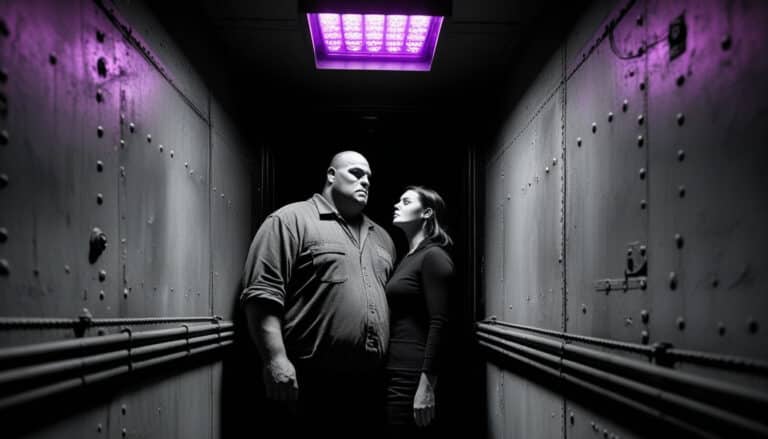
The light could not decide what it was. A caged utility bulb buzzed in its wire mouth and threw a tired sodium-amber over the cinderblock, while the high slit of window admitted a thinner, meaner white—the white of ice grinding itself against glass—and the two illuminations argued across the same wall without either winning. Bar-shadows from the cage fell in broken ladders over the floor. They looked, to Carrie, like a verdict that would not hold. Every time the generator coughed, the amber dipped and the storm took the room back, and her eyes had to learn the shapes again: pipe, panel, the ridge of a man’s shoulder, the pale of her own hands, which she could not seem to put anywhere that did not feel like an apology.
She had been translating distress since the doors locked. Through the wall the kennel wing made its small, relentless weather—a whine that climbed and failed, the metal tick of a bowl, one deep bark that did not believe in being answered. She knew the bark. She knew the particular dog who used it when the night-shift smell changed. Her body kept offering itself as the place the sound could land, and there was nowhere to spend what landed. The fire door had failed closed on its own panic. The exterior door had gone to ice. Lawrence had said both things once, in the voice of a man reading a gauge, and then he had not said them again.
He was at the transfer switch with his back to her, coat still on, the canvas gone dark at the shoulders where melt had soaked in and frozen into a stiffer dark. Municipal emergency power. Called because the backup would not hold. He had not asked her name until the second hour, and when she gave it he nodded as if filing a part. Carrie. He did not offer his own until she asked, and then only the one word, Lawrence, set down between them like a tool he expected her to leave where he put it.
“It’s dropping again,” he said.
The amber shuddered. Cold came up through the concrete into the bones of her feet and kept going, as if the floor had an opinion and the opinion was that warmth was a rumor. She rubbed her wrists without noticing she was doing it. The skin there had gone tight and foolish, the fine hairs standing, the pulse too available. She was always finding pulses. Dogs, cats, the frightened volunteer who cried in the laundry room, the man at the panel who did not want to be read and was therefore, to her, a closed book she could not stop opening with her eyes.
“I can feel it in the wall,” she said. “They can. The temperature. They know when a room is leaving them.”
He did not turn. “The animals.”
“Yes.”
A silence in which the bulb buzzed and the ice made its long, granular sound against the slit. She hated the silence for being useful to him. He worked inside it. She drowned.
“Sit on the crate,” he said, after a while. Not kindly. Accurately. “You’re burning heat you don’t have.”
She sat. The plastic was cold enough to announce itself through her jeans. From there she could see his hands, and she looked because looking was the only work left that the room would allow. They were spare hands, the nails cut square, a pale scar across the first knuckle of the right like a thread someone had forgotten to pull. He handled the leads as if each had a correct orientation in the world and his job was only to restore it. No performance. No glance back to see whether competence had been witnessed. The light found the tendon in his wrist when he reached, and lost it when the storm pushed in, and she felt the loss in her own wrist, absurdly, as if the two rooms of skin had begun, without permission, to share a draft.
Hours. Or what the failing clock of the generator made of hours. He killed the nonessential load. She inventoried what they had the way she inventoried a kennel at two in the morning: wool blanket, his, military-smelling; her fleece, already losing the argument; a thermos of coffee gone bitter and lukewarm; the first-aid tin; a coil of cord; the red bar of the heater element that glowed and did not glow and glowed again like a thought she could not finish. They spoke when speech was a tool. The latch. The fuel. The radio on his belt, which gave him only a shredded syllable and then the polite, total indifference of weather. No one was coming through that door before the ice decided to be something else.
Boredom arrived as a pressure behind her eyes. It was not empty. It was full of the small, repeating facts of the room, and of him moving through them, and of her own mind trying to anticipate the next need before it formed—his, the dogs’, the generator’s, the storm’s. She kept almost offering the thermos. She kept almost asking if his hands were cold. Each unsaid offer stacked. By the time the amber failed long enough that they had to work by the white slit alone, she was so crowded with unspent care that the sound of his coat when he finally took it off—wool dragged over wool, a dry, animal whisper—went through her like a hand.
“Here,” he said.
He held the coat out, not toward her shoulders, exactly, but into the space where a decision could be made without a speech. She stood into it because the alternative was another hour of performing self-sufficiency for a man who was not watching the performance. The coat was heavier than it looked. It smelled of cold air, machine oil, and the faint clean bite of whatever soap he used when he remembered. The sleeves were too long. Her hands vanished. For three breaths she was only held by a garment, and the relief was so immediate it frightened her.
He was close because the alcove was not a room so much as a tolerance. When he reached past her to hang the drop-light he had found in the side cabinet, his forearm passed near her cheek and she felt the heat of it before the fabric of his shirt, a narrow human weather. The bulb he clipped to a pipe came on weakly. New shadows. His mouth, in that light, was a darker line than she had been prepared for, definite as a cut. She looked at it and understood that she had been looking at it for some time.
“Your wrists,” he said.
“What about them.”
“They’re blue at the edges.” He took one, the way he took a connection he intended to test: two fingers, sure, nothing like a caress. The shock of it was not sex. It was temperature. His skin was warmer than the room had any right to have left him, and the warmth went into the thin place over her pulse and stayed there, and stayed, unbearable. She made a sound she had not authorized. He glanced at her face then—a glance that adjusted rather than asked—and did not let go.
“Body heat,” he said. “It’s what’s left.”
She could have laughed. She could have turned it into staff humor, the kind that kept a night from becoming a person. Instead she stepped in, because the coat was already around her and his fingers were already on the proof of her blood, and the boredom had eaten every other gesture. Their mouths met the way the two lights met on the wall: an argument that briefly agreed. He tasted of the bad coffee and of cold. The kiss began as warmth and remained, for a long minute, only that—a sealing of breath, the drag of his lower lip, the astonishing softness inside a man who undressed nothing and promised nothing. Her hands, still swallowed by his sleeves, fisted the surplus of cuff against the front of his shirt and held him through the wool. She felt the give of cotton and, under it, the unhurried plane of a chest that did not rise any faster for her.
He kissed her until the shaking in her wrists changed its reason. Then he stopped. Not a rejection. A limit, set with the same exactness he used on a switch. His forehead rested against hers. Their breath made a small weather between them. The dogs cried once through the wall, and the cry went into her and found, for the first time all night, a second body close enough to be confused with an answer.
“That’s enough,” he said quietly. “For now. You’ll drop if we spend it all at once.”
She nodded because nodding was easier than saying that she did not know how to spend anything by halves. He took his hand from her wrist. The absence was a bright, specific pain. They went back to the work as if the work had been waiting with its arms folded: he to the fuel line, she to the blanket, which she spread on the crate and then, after a useless moment of arranging it for a comfort no one had requested, folded again and laid on the floor beside the crate, where it was at least a thing a person could kneel on. The light steadied into its worse self, amber and white still unreconciled. Time moved by the generator’s longer and longer hesitations. She watched the slit go from black-white to a dirtier white, not dawn, only the storm thickening its mind. Her mouth felt enlarged. Every time she swallowed she tasted him, and the taste did not fade so much as take up residence.
They ate nothing. They drank the last of the coffee in turns, the rim of the thermos passing a heat that was no longer only heat. He sat at last, back to the generator housing, legs extended because there was no elegant way to be tall in a closet of machines. She sat on the blanket with her shoulder against the crate, because the crate itself had become, obscenely, a bed in her mind, and she was trying not to let the room hear that. The boredom returned, but it had changed species. It knew where his mouth was. It knew the scar on his knuckle. It pressed.
“I keep thinking I should be doing something for them,” she said. The dogs. Always the dogs, even when she meant herself. “I can hear the one in three. He paces when he’s left. He thinks if he paces long enough someone will—”
“You can’t get through the wall.”
“I know.”
“Then stop spending yourself on a door that isn’t a door.”
The sentence should have been harsh. It landed like a hand on the back of her neck, locating her. She looked at him. In the bad light his face was all economy: the cut of the cheek, the eyes that gave her nothing she could tend, the mouth she had already been inside. He was not soothing her. He was interrupting a circuit. The part of her that only knew itself as the one who must anticipate every need reared up, offended and grateful in the same breath, and she did not know which feeling to obey.
She obeyed the nearer one. She crossed the small floor on her knees because standing would have made it a decision with a speech attached, and she was so tired of speeches. His coat slid from her shoulders as she went; she let it, shrugged the last of its weight off behind her and left it lying on the wool, so that what crossed the floor to him was only her. The blanket rasped and then the concrete took her knees. His knee was in her path and she put her hand on it, and the heat of him through the work trousers went up her arm and turned, low in her belly, into a pull she stopped pretending was only cold. He watched her come. He did not help and did not hinder. When she reached his mouth the second time, the kiss had stopped being a theory of warmth. It was hunger with the manners burned off.
She opened to it. His tongue met hers and the sensation was so exact she could see it: the wet dark of his mouth, the slight scrape of a day’s beard at the corner, the way the slit-light laid a pale edge along his lip and then lost it when they turned. She made a sound into him and felt him answer with a change in pressure, deeper, still unhurried, as if even this were a sequence he would not rush and would not abandon. Her hands found the buttons of his shirt. She undid them because her hands needed a task, and because she wanted the sight of him, the bareness of a man who did nothing for display and would not ask the room to applaud.
Cloth parted. His chest was spare, the hair there dark and fine, the skin warmer than the air by a margin that felt like mercy. A mole sat just below the left collarbone, small, unarguable. She put her mouth to it because she had to put her mouth somewhere that was not a word. He exhaled, a short break in the evenness, and his hand came to the back of her head—not pushing, resting, the weight of it a new climate. She kissed down the sternum. Salt. The clean bitterness of his skin. The generator ticked and she felt the tick in her teeth.
“Carrie.” Her name, used like a measurement.
She waited for the stop, her mouth on his breastbone, and it did not come. His hand stayed on her head, resting. That was the whole of his consent: a stillness that did not withdraw.
She took it. Her fingers went to his belt and read the buckle by touch while her eyes read him, because she had always needed to do both; it was how she knew a body was all right. The belt gave. The button. She drew the trousers open and down his hips as far as the floor allowed and looked, and the looking was its own act. The belly flat and faintly ridged. The dark line of hair widening below the navel. The two hard shelves of hipbone, storm-white laid along one and amber along the other, undecided even here. His cock lay thick against his thigh and lifted as she watched, darker than the rest of his skin, a vein tracing the underside like a road she was learning by lamplight. She put her hand around him. The heat was absurd. It was the warmest thing in the building.
“Tell me if—” she began, and his hand on her head did not press, and she understood that she would not be told and would have to find it. She found it. She took him in her mouth and the taste was salt and clean skin and something darker under both, and she went slowly because she wanted to watch what each thing did—the drag of her lips down the shaft, the flat of her tongue under the head, the soft pull she gave at the crown while her hand followed. She watched his thighs. She watched the tendon in his neck appear and vanish. His breath changed, a longer draw, and he said her name again, lower, and she felt the word travel the length of him into her mouth. The bulb buzzed. Through the wall a bowl ticked and a whine climbed and failed, and she heard it and kept her rhythm. When she lifted off to breathe, the slit laid a line of white along the wet she had left on him. She was reading him and he was letting himself be read, and the permission went through her as a heat she could barely hold.
She was slick past what the cold could explain. She stood only long enough to get her jeans and the plain cotton beneath them down and off, the concrete biting her bared knees when she came back down astride him, and he did not help, and she had not asked him to. She took him in her hand and set him against herself and watched his face as she sank. The stretch came slowly because she made it slow: the thick head, the give, the long fill until her thighs met his and she was seated on him to the root, her fleece rucked up, the cold on her belly and the heat of him lodged so deep that she had to put her forehead against his to bear it.
“Like this?” she asked. There was no apology in it yet. It was only a question.
“Yes.”
One word, set down. His hands came to her waist and stayed there, following her rather than leading, the scarred knuckle a small cold pressure against her ribs. She rode him. She found the angle by the sound it drew from her and kept it, grinding down and lifting, the wet of them audible in the small room, her hands braced on his shoulders where she could feel the muscle shift each time he met her. She watched everything: his mouth parting, the cord in his forearm where he held her, the mole she had kissed rising and falling, the amber failing and the white taking his face and giving it back. When she tightened on him on purpose his eyes closed, once, and opened. When she felt him nearing it she did what she had always done; she made it happen, canting her hips, clenching, with the precision of someone who had never in her life let a creature come to grief for want of attention, and he came up into her with a hard breath and a hold on her waist that stopped her moving, and the stopping—the pulse of him, the sudden heat—tipped her after him, a shuddering she rode out against his chest with her teeth set in her own lip.
Her hands were at work before her breath was. She drew his shirt closed over the mole as if the cold could get in there, asked whether the housing hurt his back, whether she had been—
“Fuel line,” he said. He shifted her off him with care and no ceremony. “It’s lost pressure.”
She found her jeans and the cotton and put them on with the wet of him still on her thigh, because there was nothing in the room she would spend on wiping it away. He was at the line, coatless, his shirt open, a wrench turning in the mean white. Through the wall the dog in three had begun his pacing again, nails and then silence and then nails. The slit had gone from a dirty white to a grainier one, and the drop-light on its pipe had dimmed to a coal. Her body hummed, used, and the hum had nowhere to go, and so it began, as it always did, to look for work. She folded the blanket smaller. She counted the cord. She listened to the dog and could not help him, and listened to the generator and could not help it, and watched Lawrence’s shoulders and wanted, with a wanting that was almost pain, to be given the next thing to do.
When he sat again, back to the housing, legs out, she brought the folded blanket as if he had asked for it and knelt between his knees to wedge it behind his spine.
“You were cold, I thought— the metal—” She heard herself. “I was loud. I’m sorry. The dogs can hear through the—” His face gave her nothing. She went on anyway, because stopping was the one thing she had never learned. “I need— let me. I can— tell me what you want next. I’ll do it right. Just tell me.”
There it was, the old labor, climbing back into her mouth even while her hands climbed back onto him. Her hands were already arranging: his shirt pushed back so it would not bind, her own fleece dragged up as if that were the thing he would want, her knee fitted between his so the angle would be kinder on the concrete. She was staffing the moment. She was reading ahead for the flinch, the preference, the way a man might like to be touched if she could only be told the protocol. His hand came to the crown of her head while she worked, settling there the way it had before, a weight she took for permission and went on talking under.
She lifted her face. The light was worse now, amber failing toward brown, storm-white sharpening. It found the wet of her mouth and made a fact of it. It found his eyes and gave her back only attention, level and untheatrical.
“What do you want?” she asked, and heard the apology braided through it, the plea to be given a task so she would not have to survive a minute without one. “I don’t want to get it wrong. If you just say— if you want my mouth again, or if you’d rather I—”
She was still talking when his hand rose from her head.
It lifted into the narrow space between their faces, broad, the scarred knuckle catching a last thread of amber. She saw it—the rise, the turn, the room’s two lights striking the hand and splitting there, verdict and storm—and she did not, for once, see it in time to manage. Her pulse slammed once, grateful and terrified, into her lips.
His palm met her mouth.
It covered the last of the plea and held it there, the heel of his hand firm across her lips, the scarred knuckle riding the bone of her cheek, so that the protocol she had been offering had nowhere to go but back into her own mouth. She saw the wrist at the edge of her sight, the tendon standing, and she did not finish the question. His other hand closed on her hip. The grip did not ask. It turned her, and he came up off the housing onto his knees behind her as it did.
The concrete met her knee, then the cold length of pipe met the front of her thigh, and the bar-shadow of the conduit fell in a hard diagonal across her hip where his fingers had already set their claim. He kept the palm where it was. Breath broke against it and returned to her, hot, useless, hers. She reached, out of the old habit, for the angle—for a kinder placement of her knee, for the fleece that had ridden up and ought to be managed, for some small speech that would make this a task she was performing correctly—and the hand at her mouth pressed once, exact, and the reaching stopped. The vigilance, which had been a room she lived in, went quiet so suddenly she heard the generator’s tick as if it had been waiting under her pulse all night.
He drew her fleece the rest of the way up and left it bunched under her arms. The air on her back was a thin cruelty. Then his hand left her mouth only long enough to take the waist of her jeans and work them down, not far, only to where they bound her thighs together, the denim its own grip, so that every inch of him would have to be taken through the clench the cloth made of her, and the palm returned, sealing her again before she could spend the freedom on an apology. She tasted salt and the iron ghost of his skin. She felt, rather than saw, the brief shift of him at her back, a rasp of cloth, the small economy of motion by which a man frees himself without ceremony, and then the blunt, undeniable heat of him settling against her. The sight she could not have; she had the weight of his hand, the sound of his breath gone rough above her, and the dark certainty of him that needed no light to be read. She was wet already, had been since the second kiss, and the knowledge of it, unarranged, unoffered, made her shake.
He set the head of himself against her and did not ask. The first push was slow only because her body had to learn the size of him; it was not a courtesy performed for her benefit. She felt the stretch as a slow widening under a weather she was no longer required to predict—cunt parting, the thick drag of him, the bright edge where it almost hurt and then did not, because he had decided the depth and her muscles answered a decision that was not hers. A sound left her and died in his palm. He filled her in one unbroken taking, to the root, and held there, and the holding was the thing that undid the last of her management. Nothing to anticipate. Nothing to get right. His hips pinned hers toward the pipe; the shadow of the conduit cut her skin into a lit half and a dark half; his left hand left her hip long enough to brace flat against the housing beside her head, and she felt the small shudder travel down his arm into the concrete before it came back to settle low on her pelvis, claiming the bone there as if it had never left. She could feel him throb inside her, a second pulse installed where her caretaking had been.
When he drew back, the loss was so specific she would have begged for the return if her mouth had been her own. He gave it without the begging. The pace he took was deep and unhurried and entirely his—each stroke a correction of the one before, a little harder, a little more sure of the angle that made her clench and flood around him. The wet sound of it was obscene in the small room and utterly plain, like the generator’s labor. Her hands found the pipe and held, only because the body still needed a place to put its useless strength. He fucked her against that grip until the pipe’s cold printed itself on her palms and the heat of him printed itself deeper, a repeating sentence: filled, emptied to the brink, filled again. The hand on her mouth loosened by a fraction. She did not speak. The gratitude that rose in her was violent and without anecdote; it had no kennel to staff and no sentence to complete. It lived in the place where his cock opened her, in the low catch of his breath each time he seated himself, and in the ugly beauty of the slit-light laying itself along the wet of her inner thigh.
The dogs cried through the wall, one and then another, and the sound entered her and found no work to do. It passed. He shifted his grip from her hip to the low bone of her pelvis and hauled her back onto him, and the new angle made the conduit’s shadow jump across her vision as the generator stuttered—held, bound, used to the shape he required, the head of him striking a depth that turned pleasure into a weather system with no center she was obliged to manage. She came like that, as a failure of the old labor rather than anything she had arranged: a clenching that started where he filled her and ran outward until her knees lost the concrete and her mouth, freed at last because he needed the hand for her hip, opened on a raw sound that belonged to no protocol. He did not gentle it. He fucked her through the spasm, three strokes, four, the rhythm breaking only when his own release took him, and his hand came down hard and certain over her hip bones, holding her there through the last of it, the two of them shaking in the bad amber and the worse white, the generator ticking its long uneven pulse into the quiet that finally, finally, asked nothing of her at all.