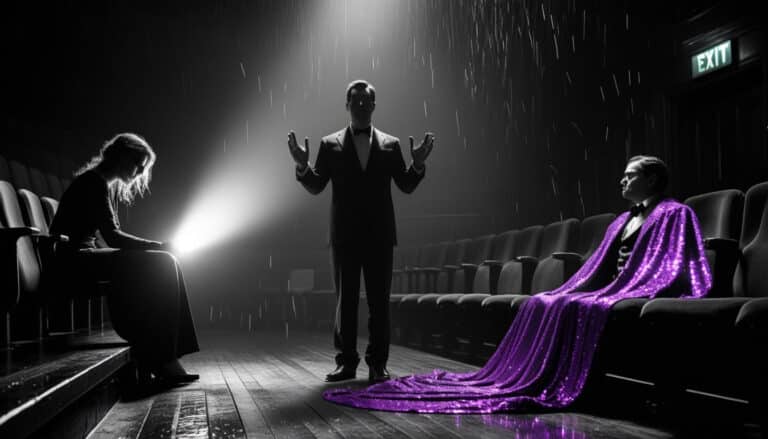
He Leaves No Trace but Mends Her Coat
She had the key half-turned before she understood the light was already on.
Not the overhead. The lamp by the chair, the one that made the borrowed flat look as if someone meant to stay in it. Zara stood in the doorway with the night still in her hair and listened for the ordinary sounds of a clean exit: a zip, a latch, the particular quiet of a man who had already decided he was leaving. What she heard instead was thread.
Ashton sat with her coat across his knees. The lining had split along the seam she never mentioned, the tear she had been living with since March. He was mending it. Not pinning it, not folding it out of sight. Needle, dark thread, the small patient tug of a stitch drawn through and set. His hands, which she had watched work a lock in under a minute and refuse to hurry even then, were giving themselves to wool as if the coat had a right to be whole.
She did not come in at once.
“You’re early,” she said.
“You’re late.” He did not look up. The needle caught the light and lost it. “The lining was going.”
“It has been going.”
“Then it was time.”
She shut the door. The click sounded louder than it should have. Her bag went to the table, where bags went, and her shoes came off by the door, and that was all she took off. The room smelled of the radiator and of rain that had not quite reached them. On the table, two cups, one of them used. He had made tea and let it go cold, which was either carelessness or a calculation she was not prepared to admire.
“Did it close?” she asked.
“Clean enough.”
“That is not an answer.”
“It’s the one the night earned.” He turned the coat, checking the line of stitches from the inside, the way he checked a hinge. “The second set of papers was where you said. The first set was a courtesy. I left the courtesy.”
“Generous.”
“Practical. A man who takes both looks like a man who needed both.”
She crossed to the window because the window was not him. The street below was the sort that forgot you if you stood still. In the glass she could see the angle of his shoulder and the dark fall of her own coat over his knee. She had never seen him do this. She had seen him wait, and refuse, and put a thing back exactly where it had been so that no one could prove he had touched it. She had not seen him decide a thing was worth keeping.
“You’ll pull the seam if you rush it,” she said, which was absurd; he was not rushing.
“I know.”
“I didn’t ask you to.”
“No.”
The word sat between them with its coat still on. Zara turned. He had finished the worst of it. He bit the thread—an old habit, inelegant, oddly exact—and smoothed the lining flat with his palm. For a moment his hand stayed there, over the place her shoulder would be if she were wearing it. Then he folded the coat once, wrong side in, the lower edge still open where the needle had not yet reached, and set it on the arm of the chair as if the arm had been cleared for that purpose.
“Tea’s dead,” he said.
“I noticed.”
“There’s water.”
“I’m not thirsty.”
He nodded, the way he nodded when a cover held and there was nothing left to adjust. He should have stood. He should have reached for the bag by the door, the one already packed to the standard they kept: nothing personal, nothing that would argue if it were opened. Instead he leaned his head back against the chair and let his eyes close, not all the way, the way a man does when he is counting whether he can afford the next hour.
“You can sleep on the train,” she said.
“I can.”
“The six-ten still runs.”
“It does.”
She waited for the rest of it. The rest did not come. His breathing changed before his posture did—slower, less arranged. One hand remained on the chair arm, near the coat, not quite touching it. The other had gone slack over his thigh. She had watched him counterfeit sleep in worse rooms than this. This was not counterfeit. The lamp made a tired man of him, and the tiredness was unprofessional, which in Ashton was nearly the same as naked.
She should have woken him. She should have said the train again, or the lock, or the second set of papers, any sentence with a job in it. She stood at the window and did none of those things. The stitch in the lining would hold. She could see that from here, and she hated that she could see it.
His mouth moved before his eyes did.
“I’m done guessing,” he said.
The voice was low, unguarded, scraped clean of the ironies they used in place of tone. She did not answer. Answering a man between waking and sleep was a kind of theft, and she had rules about theft even when the night did not.
“Where you want me,” he said, as if the first sentence had been only the hinge. “I’m tired of it. If you mean to send me out, do it before I ask to stay.”
His eyes opened on the last word and did not quite find her. They found the lamp, then the coat, then the middle distance where a person stands when they have not yet decided to be in the room. He blinked. The professional quiet came back into his face by degrees, embarrassed to have been absent. He straightened half an inch. His hand left the chair arm.
“Ignore that,” he said.
“No.”
It was out before she had chosen it. He looked at her then, properly, and the looking cost him something she could measure because she had made a study of him for years. Color at the throat. A stillness that was not calm.
“I was asleep,” he said.
“You were not asleep enough to be lying.”
“That’s a generous reading.”
“It’s the one the sentence earned.”
He almost smiled. It failed at the corner of his mouth and became, instead, attention. “Zara.”
“Don’t.” She heard how thin it was. “Not the name. Not yet.”
He accepted it the way he accepted a change in plan: without argument, without making her repeat it. His hands rested on his knees. He did not reach for the bag. He did not stand. He watched her as if the next move were hers and he had already decided not to help her make it.
She stayed where she was.
The radiator knocked once, a small domestic indecency. Rain touched the glass and thought better of it. She could hear her own pulse in the place just under her jaw, which was ridiculous, which was information. Across the room he was entirely awake now. She could see it in the set of his shoulders and in the way he did not fill the silence for her. Awake enough to refuse. Awake enough to be held to whatever she did next. That had been the condition, though she had not said it aloud and would not.
She took one step.
The floorboard near the rug knew her weight and reported it. She stopped. Her hand had lifted without instruction—an old gesture, the one she used when she was about to make a point in a room where points were dangerous—and she lowered it again, slowly, so that the lowering would be visible. He followed the hand down. He did not offer his own.
“The six-ten,” she said, and heard the train for what it was: a sentence she could still spend if she wanted the night to remain grammatical.
“Still runs,” he said.
“Yes.”
Another step. Smaller than the first. She felt foolish and did not hurry to be rid of the feeling. Hurry would have been a kind of answer, and she was not prepared to give him an answer he could later call weather, or fatigue, or the loose talk of a woman who had not waited for his eyes to clear. The needle he had left on the side table held a fine edge of light. She looked at it so she would not look at his mouth.
Halfway, she halted again. Close enough now that she could see the tiredness he had not managed to put away: the faint crease at the outer corner of his eye, the place where the day’s concentration had lived and then surrendered. Close enough to smell cold tea and wool and the clean, ordinary scent of his shirt. Not close enough to touch. She had arranged it that way without seeming to.
Her breath came up full of words. She held it. The words were precise, ironic, survivable. They would have told him where he stood and left her somewhere else. She let the breath go unused.
He did not lean forward. He did not close the last of the distance out of manners or mercy. His gaze stayed on her face, then dropped, briefly, to her hands, which were empty and no longer pretending to be busy. When he looked up again there was no question in it he was willing to ask twice.
“If you’re going to send me out,” he said, quiet, each word set down where she could refuse it, “now would be the time.”
She went the rest of the way. There was no counting in it now; the floorboard said nothing, or she did not hear it. Two steps, and the second was not smaller than the first, until the side table was at her hip and his knees were at hers and there was no room left in which to be undecided.
Her hand rose a second time—not to make a point, not to wave the moment off—and hovered, open, a little unsteady, in the air just above where his hands rested. She did not take them. Not yet. The inch between her palm and his skin was the whole argument, and she held it there, and waited to learn whether the inch would remain an inch.
She let it fail.
She took his right hand by the wrist, not the fingers, and lifted it from his knee. He allowed the arm. He did not improve on the direction. She turned his palm and set it at the left side of her waist, just above the hip, thumb along the seam of her shirt, and kept her own hand over his until the fingers stopped hovering and took the weight they had been given. Then she left them there.
The other hand she drew up more slowly, because slowness was the only honesty she trusted, and laid it flat against her ribs, high on the right side, where her breath would reach him whether or not she permitted speech. She pressed once, a thumb’s width lower, and felt him answer it by fitting his palm more exactly to the place, not by seeking a better one. Here. And here. She did not say them.
He looked at her hands, then at his own, as if confirming an inventory. His breath went shallow and he made it deep again, deliberately, so that she would hear him do it. He did not ask if he had understood.
“The walls,” she said. The borrowed flat had always carried a voice farther than it had any right to.
“I know.”
She kept his hands where she had put them. Her own went to the buttons. The first opened without argument. The second. Cloth whispered, a small domestic sound, and his breath changed under her ribs—not a question, a registration. When the shirt loosened she drew the fabric out from beneath his upper palm so that the hand she had assigned him ended on skin without his having reached for the privilege. He went very still. Then, surer, he let his fingers settle—same place, no travel. She did not correct him. She watched the knowledge arrive in his face and refused to decorate it.
The third button caught on its thread.
“It catches,” she said, low, to the button, in the voice she used when she meant him. “If you hesitate.”
His hand at her waist tightened by a degree and did not wander. A laugh broke in her, brief and unprofessional, and she smothered it against her own teeth before it could become a sound the next room might claim. He heard what was left of it. She knew because the palm at her ribs answered, more certain than before, and because he did not smile in any way she would later be able to call manners.
His cuff was in the way. The left sleeve had bunched against her side, a button biting where she had given him work to do. She took the cuff herself, worked the button through, and turned the cloth back once so his wrist lay bare along her ribs. He exhaled. The breath touched her throat and went no farther. She undid the other cuff for symmetry, though symmetry was a courtesy and she was tired of courtesies, and he flexed his fingers inside the order she had set, testing the length of what he had been allowed. He did not exceed it. Left where he was, he grew quieter in the hands and more exact, like a man who had finally been shown the lock and would not insult it by forcing the neighboring one.
There remained everything below the shirt, and his hands were in the way of it. She lifted them—his right from her waist, his left from her ribs, by the wrists, the way she had placed them—and set them on the arms of the chair. His fingers closed on the upholstery as if it had been issued to him. He did not look down to see what she did next. He looked at her face, and let the looking be the only liberty he took.
Her belt first. The buckle made its small metallic admission and she let it. The button at her waistband; the zip drawn down with the care of someone disarming something, not because haste would have been dangerous but because haste would have been an answer. She bent to take the cloth down over her hips, and the shirt fell open as she bent, and she did not gather it. One foot out, her hand on the back of the chair beside his head for balance. The other foot. The trousers went to the floor, and she sent what was under them after it, and stood between his knees in a shirt she had unbuttoned for him and nothing else. She did not cover herself. Covering would have been a kind of speech.
His belt was easier, being his. She had watched him buckle it in a hundred borrowed rooms on a hundred mornings and had never once let herself picture the reverse. She pictured nothing now. She did it. Leather, the tongue of the buckle, the button beneath, the cloth parted only as far as the work required. When she took him in hand he made no word of it, only a pause in the breath, and his fingers on the chair arms whitened and stayed.
She reached past his shoulder then and lifted the coat from the arm of the chair, where her knee would need to be, and laid it over the chair back behind him so that the mended lining hung down against his shoulder. He did not ask why. She took his hands again, wrist by wrist, and gave them back their posts—the right to her left hip, the left to her right ribs, both on skin now—and arranged her knees at either side of his on the seat and let her weight answer the question his confession had been too unguarded to finish.
She took him in. The taking was hers, set with the same deliberation she had used on his wrists: a downward inch, and the breath that went with it, a pause to let him feel it, another inch, until the slow fact of him filled the place the distance had been and there was nowhere left to pretend the distance had been theoretical. He held the positions. She felt the effort of it in the cords of his wrist where it lay bare against her ribs, a discipline so complete it was almost cold, and then not cold at all. The lamp made a frank thing of his mouth. He did not close his eyes. He watched her as he had watched her cross the room: wholly there, wholly hers to refuse, and no help at all.
She moved, and the chair spoke once, and she stopped until the silence took the chair back. The walls were thin and the habit was older than the walls. What remained was breath, and cloth, and the small stuck sound of her shirt where it had fallen between them and would not lie smooth. His hands learned the meter without being relocated. When she leaned, the hand at her hip held her to the place. When she straightened, the hand at her ribs followed the breath and stayed inside its orders. She did not praise him. He was past needing it.
“If you—” she said, and the clause opened onto nothing she was willing to furnish: stay, or ask, or the name she had forbidden.
“I wasn’t going to—” he said, and did not supply leave, or guess, or speak.
Neither of them completed it. The unfinished thing hung between their mouths, more useful than any sentence they might have survived.
She kept her pace because pace was the last authority she had not handed him. Heat gathered in her without elegance, a long refusal giving way the way a seam gives, not all at once and then, ruinously, all at once. She turned her face into his shoulder, where the wool hung from the chair back over the cloth of his shirt, and her mouth found the mended lining, and what sound she made stayed there, brief, caught, unfit for the corridor. Her body answered in small exact convulsions she would not have permitted an audience. His hands did not abandon their posts to chase it. He held her where she had taught him to hold her, through the whole undoing, as if the lesson were the point and his own finish had not yet been put on the table.
For a moment after, he was still exact.
Then the lesson failed him.
She felt the economy leave his body: breath breaking its arrangement, hips finding her in three movements none of them composed, a messiness she had never seen in his hands and could not now correct, because that would have required her voice and her voice was still in the wool. He held her harder than the places had strictly asked and did not seem to know it. The chair objected. He did not hear the chair.
“Zara,” into the side of her hair, too clearly for the walls.
She did not give it back to him. She turned her face a fraction deeper into the coat so that whatever her breath did next would not become an answer. He finished in her without grace, shaking once, a man who had spent years refusing to hurry and had, at the last, been spent. His hands remembered themselves late. One eased at her ribs. The other remained at her hip, loyal past the end, until she lifted it herself and set it down on the arm of the chair, dismissed from duty.
They breathed. The radiator knocked, indifferent. Somewhere beyond the thin wall a pipe ticked and was not their concern.
She rose off him when she could, one knee and then the other, the chair giving her up with a last word, and stood on legs that were not entirely her own. Her clothes were where she had left them. There was no ceremony in the putting on: the cloth drawn up, the button, the zip, the belt left hanging. Then the shirt—the lower buttons, the one that had caught, the edge drawn back into an order that would not survive inspection and did not have to. Her fingers knew the work. His cuffs she left open. She did not meet his eyes. To look at his face would have been to take stock, and she was not ready to count in the light.
He shifted, not away. The coat had slipped from the chair back and slumped against his arm. He touched the lining with two fingers, the way he touched a hinge he had already tested.
“I didn’t finish the lower edge,” he said, as if the night had been for nothing else.
“The stitch will hold.”
Neither of them laughed. Neither reached for the pretense of sleep. The cold tea kept its counsel on the table. The needle glinted and was only a needle.
The bag was still by the door, packed to the standard, arguing for the six-ten without saying so. She crossed the room to it on bare feet that still remembered him, every step at its full length, and took it by the strap. She brought it back and set it on the cushion beside his hip, the canvas resting against his thigh, where a thing meant to remain might be set without a speech. The strap slid once and went quiet.
He looked at the bag. He looked at her hand leaving it. He did not reach for the door, and he did not reach for her wrist, and the not-reaching was so deliberate she could read it from the angle of his mouth alone.
She stayed standing in the narrow space she had crossed, her belt hanging open at her waist, her shoes where she had left them by the door. He stayed in the chair with his cuffs open and the coat’s unfinished edge under his fingers. The silence that followed was not the old silence, the one that had always been dressed for leaving. It had weight. It had contents. She could have listed them—the hands, the wool, the train that would run without him, the name—and she did not. Across from her, by the care with which he also did not speak, she understood that he was keeping the same ledger and would not read it aloud.
They let the inventory stand uncounted, and the flat, for once, did not correct them.