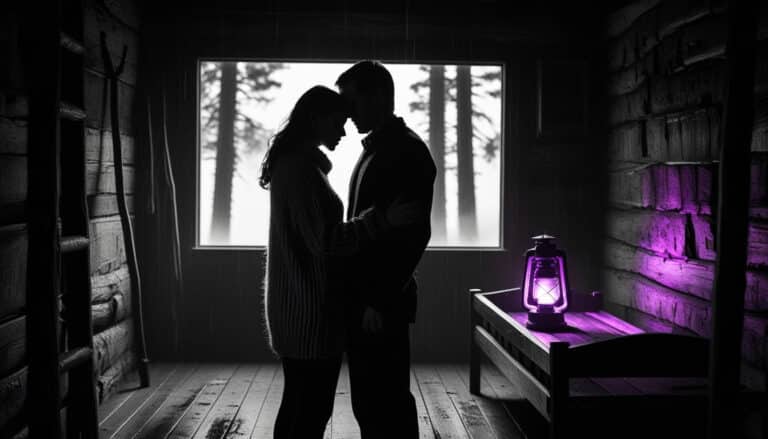
New Doctor Stranded with Obedient Advisor
“You will not be alone with me,” Claire said.
She was quoting. The sentence was a year old and her own; she had said it once, in a corridor, and he had kept it so exactly that she had never needed to say it again. She said it now from the threshold, rain in her mouth, one hand still on the latch as if a quotation required a witness. The cabana took the words and did nothing useful with them. Heat came through the louvers. Salt came with it. Somewhere under the veranda the tide slapped the pilings, regular as a clerk.
Stephen did not sit. He had stood when the latch turned, and he went on standing, because sitting would have looked like a decision to stay and standing, he suspected, looked like a decision to leave, and he had made neither. His bag was on the only chair. He left it there so the chair could not be offered. Forty-six was old enough to know which of his courtesies were cowardice. He kept his hands at his sides.
“The foundation double-booked it,” he said. He heard himself edit the sentence as it left him, trimming the apology off the front. “Scholars. No names. I have the key they sent. I did not know the other was you.”
“You know it now.”
“Yes.”
A year of not writing had made his voice feel like a borrowed instrument. He waited to see whether she would correct him, the way she used to correct a claim that had arrived one inference too early. She did not. She set her bag down inside the door, which was not the same as coming in, and looked at the room the way she looked at a text she already suspected of bad faith: one bed, one chair with his bag on it, louvered walls, a veranda that quit in black water. The floor was the color of wet teak. There was nowhere to put a person that was not within an arm’s length of the other person. He had already done that sum. He could see her doing it.
“The boat is canceled,” he said. “The path on the windward side is an hour if the hour exists. I walked ten minutes of it before the light went. It does not exist.”
“Then we are not alone,” she said. “We are inconvenienced. Those are different words.”
“They are the same room.”
She almost smiled. He watched her refuse it. That refusal did more to him than the rain had.
Claire took the veranda because the veranda was a preposition, not a place. Outside. Beside. Not with. She had lost a shoe to a root and had not gone back for it; on the veranda she toed off the other and left it by the post, because one shoe was a comedy and the boards were warm under her bare feet. The rain came sideways enough to find her shins and not her face. She could see him through the louvers if she wanted to. She did not want to, which meant she knew exactly where he was: still on his feet, still not occupying the center of the room, as if center were a verb he had declined to conjugate.
Eight weeks. The committee had stood. Someone had said Doctor, and it had been her name attached to it, and she had thought, absurdly, of him not being in the room, which had been the point. She had written the rule so that her work would not have to survive a rumor. No letters. No conferences. No rooms with a door. Until she was no longer his. He had obeyed her to the letter, which she had wanted, and which she had not, until this afternoon, forgiven him for.
“You can have the bed,” she said, to the water.
“I will take the floor.”
“That is not what I said.”
“It is what I am doing.”
She turned. He had not moved. Of course he had not. Precision, in him, was a kind of fasting. She had spent a year furious at it and a year grateful, and the two years were the same year.
“If you sleep on the floor,” she said, “you are still in the room.”
“If I sleep on the veranda, I am still on the island.”
“The island is not the rule.”
“No,” he said. A pause. She heard him strike a clause and let it die. “You are.”
The tide hit the pilings again. She put her hand on the post so she would not do anything with it.
He would not sit, and she would not ask him to, and between those two abstentions the cabana arranged them anyway. She came in when the rain stopped being a mood and became a fact. She left the door open, which changed nothing; the louvers already made a fiction of inside. Water ticked on the boards. Her shirt had gone dark at the shoulders and the spine. He looked at the floor so he would not look at the shirt, and the floor offered him her feet, bare, a thin cut on the ankle she had not mentioned. He edited the question down to nothing and still almost asked it.
“There is a lamp,” he said.
“I see it.”
“I was not offering to light it for you.”
“I know what you were not offering.”
She lit it herself. The flame made the room smaller. He watched the shadow of the louvers stripe her wrist and thought, with the useless accuracy that had got him through faculty meetings and not through this, that he had not been this close to her hands since a seminar in which she had passed him a page and not let their fingers meet. She had been better at the not-meeting than he was. She was better at most speeds. He waited. It was what he knew how to do, and it had begun to feel like a lie he told with his posture.
“You defended,” he said.
“Eight weeks ago.”
“I heard.”
“From whom?”
“A subject line. I did not open the rest.”
She stood with the lamp between them, which was not enough distance and was all the distance the room contained. “Then you know the condition expired.”
“I know you have not said so.”
“I am saying we are negotiating a floor.”
“Yes.”
“Say it back.”
He did. “We are negotiating a floor.”
The sentence sat between them, dressed as logistics, meaning the other thing so nakedly he was ashamed of them both. She nodded as if he had cited correctly. Her hair was stuck to her throat. He did not consider her throat. He considered the ethics of standing: whether a step toward the lamp would be read as approach, whether staying beside the chair would be read as a sentry’s claim on the door, whether sitting at last would be read as settling in. Every reading was a fault. He stayed on his feet, and felt the staying become its own offense.
She took the step down to the veranda again because the room had begun to keep a count of her breaths. The rain had eased into a needling mist and then changed its mind; it came hard off the water, warm as a cloth. The other shore had gone dark. The storm had taken its power, or its people had conceded the evening; either way there was no light across the water and no sound but the water. No one could hear them. She had designed the rule for corridors and inboxes and the decent accident of other people. Privacy was a pressure she had not stress-tested. It removed the excuse and left the wanting standing there with its hat in its hands, well-mannered, enormous.
“You should dry off,” he said from inside, which meant he had thought about her body and routed the thought through a decent verb.
“I am fine.”
“You are shivering.”
“I am wet. Those are also different words.”
A pause. She could hear him choosing. When he spoke, the formal register had come back into his mouth like a brace.
“Doctor.”
The title. The new one, the one the committee had given her, used as a fence.
“Don’t,” she said.
“It is accurate.”
“It is late.”
“Yes.”
She hated him, briefly and completely, for being the man who would still hand her the title in a room with one bed, and she hated the year for teaching him that this was what she had asked. She had asked. She had meant it. She meant it now, on the step, with the dark under the veranda moving like an animal and his silence standing in the room as carefully as a body.
“If the rain comes through the louvers,” she said, “the floor will not be a solution.”
“Then I will stand.”
“All night.”
“If that is the remaining grammar.”
She laughed once, a small ugly sound, and killed it. “You cannot stand all night.”
“You cannot assign the bed to me and then police the distance from the veranda. The room is twelve feet. I measured while I was still allowed to be a man waiting for a stranger.”
“And now?”
He did not answer. The not-answer was so loud she put her forehead against the post.
Stephen counted the slats. He counted them because the alternative was to count the months, and the months had been a discipline, not a number: no letter, no conference hallway, no sentence begun and deleted at two in the morning. He had kept it because she had asked, and because he would not be the man who turned her work into a story other people told. The condition had expired eight weeks ago. He had not written even then. Expiration was not permission. Permission would have to come in her voice, and she was spending her voice on floors.
He moved only when the mist thickened, and only as far as the doorframe, one hand on the wood, the rest of him withheld. She was a shape against the water. The cut on her ankle had a thread of blood in it, already browning. He looked at that because it was a fact that required nothing from her.
“You are hurt.”
“A root.”
“I have a cloth.”
“If you bring it out here, you are on the veranda.”
“If I do not, I am a man watching you bleed for the sake of a preposition.”
“Stay where you are.”
He stayed. The doorframe was a compromise so thin it insulted them both. Rain found the back of his hand and made the skin feel borrowed. He could smell the island more clearly than he could see it: wet leaves, something flowering past its date, the mineral breath of the water. The cabana kept them the way a parenthesis keeps a clause—in, and not finished.
“I did not come for you,” she said.
“I know.”
“The invitation said scholars.”
“Yes.”
“If I had seen your name I would have declined.”
“Yes.”
The third yes was the one that cost him. He offered it anyway, because it was true, and because she deserved the truth in the smallest available unit. She turned her head. In the lamplight her face was all argument and no conclusion. He had loved that face in rooms where loving it was a professional crime, and he had not called it love, even to himself, until the crime had a closing date and he still could not send the letter. He did not call it love now. He held the doorframe and let the word remain a thing they were not saying, which was the only honest way he knew to keep it in the room.
“You could walk,” she said. “The path is bad. It is not a wall.”
“In this, in the dark, it is a wall.”
“You are a careful man. You would not fall.”
“I am a careful man. I would not leave you in a storm because the alternative required me to be brave in a direction you have not licensed.”
She closed her eyes. “You make obedience sound like a virtue.”
“You asked me for it.”
“I know what I asked.”
“Then tell me it is over.”
The sentence escaped him. He heard it hit, too plain, unedited, a draft he would have cut. Her eyes opened. For a moment the subtext failed them both, and there was only the ask, standing in the doorway with rain on its hands.
She did not give him the four words. She gave him logistics, because logistics had not yet betrayed her.
“The bed stays empty,” she said. “You take the chair. I take the step. If the rain comes in, we renegotiate from opposite walls. We do not discuss the year. We do not discuss the committee. We do not—”
The latch on the windward shutter gave.
The sound was not large. It was exact: wood on wood, a crack like a rule breaking in a quiet room. The louver blew open and struck the outer wall, and the cabana flinched, and the dark on the veranda lurched at her back.
Claire’s hand left the post.
Her toe found the sill a half-inch early.
Stephen let go of the doorframe.
They met in the doorway, because there was nowhere else to meet. Her weight came up through the sill and into him, and he let go of the wood to take it, and the taking put the breath out of both of them before either could spend it on a word. The knock of ribs. Her forehead against his mouth, hard enough that he tasted rain and the brief bright fact of his own lip. His hands went to her back, which was where a person had to be held if the floor was not going to finish the argument. Her hands went into his shirt and knotted there, as if the cloth had offered itself as a citation and she had accepted it without checking the page.
For one second there was only the knock of it. Then something else, arriving late and with no dignity at all, the kind of feeling he would have struck from any sentence he trusted: that she was here, and he was here, and a year of discipline had not managed to put either of them anywhere else. He felt it reach her a beat after it reached him—a change in her breath, a sound she started and did not finish. She got her forehead off his mouth and set it against the bone of his shoulder, where she would not have to show him what her face was doing.
“Be alone with me,” she said.
Four words. They went into the wet cotton and stayed there. He heard them. He did not answer, because an answer would have been a recital, and she had not asked for the repeal read back to her. He did not let go. His hand spread once across her spine, a correction of grip more than a caress, and through the open shutter the rain came sideways across the room and found the backs of both their necks.
He kept his mouth shut against her hair and counted nothing. The months were over. If he spoke he would edit, and if he edited he would make a smaller thing of a sentence that had already cost her the whole year. He held on until his arms shook with the effort of not turning the hold into anything quicker. The cabana ticked. Water on the louvers. The tide, indifferent, under the boards.
“You’re bleeding,” he said, which was not the sentence, and was the only one he could trust at that volume.
“A root,” she said into his shoulder. “We established the root.”
“Yes.”
Her laugh started and died when his knuckles, shifting to keep them both upright, met the bare skin above her collar where the wet shirt had given up. The sound she did not make was louder than the one she had. He went still.
“I should—”
“It was four words. Don’t annotate them.”
“I am trying not to.”
“Try less.”
He made a sound that might have been a laugh if he had had the breath for it. His hands remained where they had landed. Staying became, Claire understood, the first choice either of them had been permitted to make in the room. The second would have to be smaller, or they would frighten it off. She took her forehead from his shoulder and stood in the circle of his arms a step inside the door, facing him, rain running off both of them onto the teak.
“The buttons,” she said.
“They won’t—” He tried one. The cloth was plastered to her; the button held as if it had professional objections. “They stick.”
“Then negotiate.”
“I am.”
“You’re hovering.”
“I am being exact.”
“You are being late.” She got her own fingers on the second button and lost it to the wet. A half-sentence came out of her and stopped. He waited. The waiting, this time, was not a posture. It was a hand that would not take what had not been put into it. He looked at the button and not at her face, which was the only thing in reach he had not yet been given.
“If I tear it—”
“It is already a loss.”
“Your shirt.”
“Yes.”
He did not hover then. The placket went with a sound she would remember longer than the shutter—four buttons across the teak, one of them striking the leg of the chair—and the shirt hung open, and the air that moved through the room, wet and warm and smelling of the water, found the length of her. Then his hand did: flat at her collarbone, not moving down, only confirming the skin he had already found by accident. She shivered, which was weather and was not.
“Dr. Ellison,” he said.
The formal voice. The fence, offered the one last time, because he would not be the man who mistook a collision for a license even after she had handed him the license in four words. She heard the year in it. She heard the ask he was too careful to dirty with a verb.
Claire took his wrist. She guided his hand down the open front of the shirt, over the ribs the wet cloth had taught him, until his palm was flat against her stomach and the rain on his fingers met the rain on her skin. She said his name without the title.
“Stephen.”
He closed his eyes. The name did what the title had been preventing. His hand stayed where she had put it, and the heat of it was so plain it was indecent, and the indecency did not move her hand off his wrist.
“Here,” she said.
“Yes.”
The zip of her skirt stuck halfway down her hip. He breathed an apology into her hair and tried again with his free hand, slower, and the thing gave all at once, and the wet cloth slid and she stepped out of it, his knuckles dragging bare hip on the way. Only then did she let go of his wrist, because she had decided she wanted both hands for him and could not have them otherwise; she felt him register the release as a question and answered it by going to the top button of his shirt. They stood a step inside the door and negotiated the rest the way they negotiated everything: half-sentences, a correction, a pause in which his forehead rested against hers and neither of them spent the pause on a kiss. She noticed the omission and let it stand. It was the one thing in the room they had not spent, and she found she wanted something kept back, for a room they chose instead of one assigned to them.
“The bed,” he said.
“Is the only dry place.”
“That is not why I said it.”
“I know what you are not saying.”
He walked her backward not as a maneuver but as a continuation of the hold, until her calves met the bed and the dry coverlet took the rain off the backs of her knees. What was left of her shirt came off in one drag, her arms clearing the wet sleeves, and hit the teak, flat and wet. She had started on his buttons in the doorway and lost the argument halfway, occupied with the fact of his chest under her hands; she finished it now and pushed the shirt off his shoulders, and it fell at the foot of the bed. His belt. The trousers, wet to the thigh, that he had to help with and did, without a word, stepping out of them and the shoes beneath them, standing to let her be exact about him. Then she sat, and lay back, and reached up for his wrist again—the same wrist, the one she had surrendered in the doorway and now took back as if reclaiming a loan—and drew him down with her.
They were not loud. The island would have permitted it. A year of not speaking had made sound feel to Stephen like a door left open onto a corridor. What the cabana kept was breath, and the wet tick of the louvers, and the tide. When his mouth found her throat it was instead of a sentence. He felt the shape of the unfinished thing against her pulse—something that might have been her name, or the other word, the one he had not said even to himself in any room that could be quoted—and she did not ask him to finish it. She turned her face into his wrist and breathed.
“Wait,” he said, not as refusal. His hand had reached the last of her clothes and stopped, the way his pen stopped before a line he was not sure he could improve. “Here?”
“Yes.”
“If I—”
“Don’t narrate it.”
“I need the—” He lost the noun. She took his hand and showed him the pace, a correction as clean as any she had ever made in a margin. He followed it. The care in him had not gone anywhere; he spent it, deliberately, on taking nothing beyond the instruction. When she changed the instruction—when she drew him over her and into her, and her breath broke on the change—he changed with it, immediate, precise, the man who edited three times, editing now against her skin.
“No,” she said, once, when he went too gentle, and he understood which no she meant. “Yes. There.”
The word she almost said caught behind her teeth. She bit it off. It might have been please. It might have been the whole indecent truth of the year. His mouth stayed at her throat and did not ask. Outside, the rain leaned on the louvers and was not a witness. No one on the windward shore could have heard them if they had shouted. They did not shout. The quiet was the last habit of the rule, and it made every breath indecent in a way volume would have cheapened.
She came first, sharp, a break in the sentence rather than a conclusion. Her hand went over her own mouth out of a habit no privacy had yet repealed. He felt the sound she refused the room arrive anyway—in her ribs against his chest, in the shudder that went through her and through him where they were joined—and he held still inside her and did not chase his own end into hers. Finishing together would have been a performance. They had not earned a performance. They had earned the staggered, unlovely fact of it.
He lifted his head from her throat and watched her face, because he had spent a year not being allowed to. The lamp. The wet hair at her temple. Her eyes open and very direct, as if she had just been proved right about something and resented how much it had cost. The rule was gone from the room and nothing had been crowned in its place except her, breathing, here, not interested in this minute in being anything but held. When he followed it was slower, his forehead lowered to hers, a shaken breath he did not dress as language. It felt less like arrival than like being allowed, at last, to set something down. The cabana took that, too, and did nothing useful with it.
They did not sleep.
The rain thinned until it was only the tick again, and the quiet got awkward in a way Claire could use; it made the next sentence somebody’s job. She sat up. He had already found his trousers and pulled them on and crossed the room barefoot, and sat down on the floor just inside the open door with his back to the frame, bare to the waist, which was either tact or retreat and she did not yet have the evidence. Her shirt was a torn dark loss on the teak. She found his at the foot of the bed where she had pushed it off him, and put it on. It smelled of rain and of the particular soap of a man who packed as if a stranger might inventory his bag. She did not do up all the buttons. She stepped past him over the sill and sat sideways on the veranda step, her back against the post, one knee drawn up, the other leg stretched back across the threshold into the room so that her bare heel rested on the boards a hand’s width from his thigh. The easing weather put its hands on her shins.
Her ankle was a fact again, the thin cut browning, no longer an ethics problem. He did not touch it. He looked out at the water, mannered to the point of comedy, and she watched him recognize it and decline to fix it.
“No hiding,” she said, to the dark. “No supervision. No pretending this was weather.”
He was quiet long enough that she knew he was striking clauses.
“The first one,” he said. “Define it. I will not be careless with your name in a room that isn’t this one. That is not hiding. That is—”
“Manners. I know. I am not asking you to be careless. I am telling you we do not return to the corridor voice and call it virtue.”
“No supervision,” he said. “There is none. You are not mine to grade.”
“I was never yours to grade. That was the point of the year, and also its cruelty.” She hooked her foot behind his knee and pulled, not hard. He came a few inches nearer on the floor and laughed once—a sound he had plainly not approved in advance—and she turned to look at him. He looked back, almost offended by his own mouth. She did not smile. She let him see that she had heard it, and left her heel where it had landed, against his knee, the cut no longer between them as a pretext.
“And the weather,” he said.
“Was a shutter and a root and a foundation that cannot count beds. It was not a cause.”
“No.”
Across the water a generator kicked on. The other shore assembled itself out of nothing in a thin electric line: still there, still inhabited, an hour of roots and rock that the morning would require them to walk. She watched him watch the light, and could see the story already forming in him, bad, necessary, the kind of paragraph a careful man wrote so that other people would have something dull to repeat.
“We say the booking,” he said. “We say the storm. We do not say—”
“We say double-booked, which is accurate and sounds like incompetence, which the foundation will prefer to mystery. You took the floor.”
“I did not take the floor.”
“In the story you took the floor. I took the step. The bed remained a theory.”
“That is a lie.”
“It is a sentence we can both live under until we are off their island. After that you may be as precise as you like, in private, with me.” She glanced at him. “You will want to say ‘chaste’ somewhere. Don’t. It will sound like a confession.”
“I was going to say ‘inconvenient.’”
“Worse. Inconvenient is what we called it when we meant the other thing.”
“Separate, then.”
“Separate is a sulk. Try ‘stranded.’”
“Stranded implies we attempted to leave.”
“We did attempt. The path was a wall. You said so. Use your own clause if you’re going to be precious about it.”
He almost smiled. She watched him refuse the full size of it and keep a smaller one, which was more intimate than the laugh had been. The generator hummed. Salt came through the louvers with what was left of the heat. His shirt was too large on her at the shoulder and exact, somehow, at the wrist.
“They will ask if we knew,” he said.
“We did not know. That part is clean. Do not improve it.”
“I wasn’t going to improve it.”
“You edit when you’re frightened.”
“I edit when I am awake.”
“Then be asleep for one paragraph. Say it plainly and let them be bored.”
He considered the water. The line of light on the far shore had steadied into something a boat might aim at. He put his hand on the floor, not on her, and she noted the distance he had chosen and the distance he had not, and found both acceptable.
“The letter,” he said.
“Which letter.”
“The one I did not send. Eight weeks ago. The condition expired and I sat with the page and I did not—” He stopped. “I would like it on record that there was a page.”
“Was it good.”
“It was three drafts. The third was worse.”
“Then you were right not to send it.” She pressed her heel into his knee, once, a footnote. “Send me the first.”
“The first was indecent.”
“I am wearing your shirt on a veranda. Calibrate.”
He laughed again, lower, and this time did not look offended. The tide hit the pilings and withdrew. Behind them the lamp had burned down to a stubborn blue, and the room it had made smaller was still twelve feet, still one bed, still a chair with a bag on it that neither of them had moved. Across the sill their two bodies made a sentence the cabana had not written and could not revise: a man against a doorframe, a woman against a post, one bare foot resting on one bare knee, the dark between them doing nothing useful at all.
“Dawn in two hours,” he said.
“Then we have two hours in which to say nothing you can be quoted on.”
“I have been practicing that for a year.”
“I know,” she said. “Stop.”
He did not answer. He let his hand leave the floor and close, lightly, around her ankle, below the cut, and that was the end of the quotation.