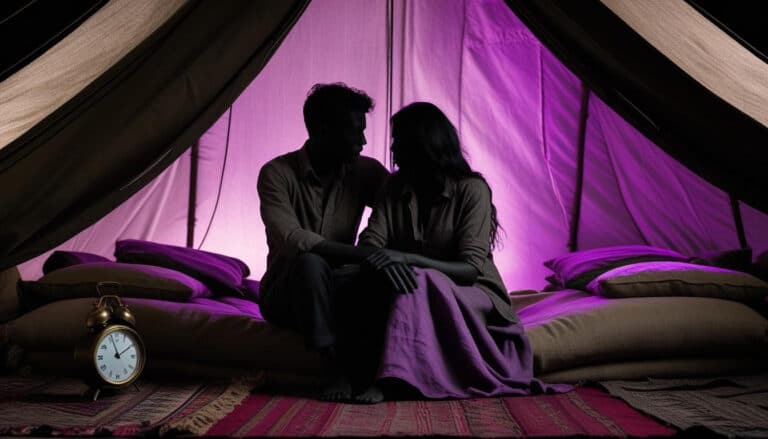
Husband Watches as Wife and Mechanic Wait
He watched her from the hall, where the coats made a dark narrowness and the kitchen was only a lit fact at the end of it. They ate in the kitchen; it was the one room the house kept warm in January, and the table stood under the window with the radio on the shelf above the sink. Rebekah’s left hand rested beside her plate. The thumb came up, found the wedding band, and turned it once—not a worry, a verification, the same economy she used on a loose weft. Then the hand went still. She did it when Jamal was at the table. Vince had been collecting the instances since Friday and had not yet allowed the collection to become a conclusion. She did not know she was seen.
He came in with the corrected page still in his head, a torque figure he had been worrying the way other men worried money. The manual could wait. That was what he had told himself when he asked Jamal up: the yard was closed, the diagrams were clearer on a kitchen table than on a bench in the wet, and a meal was only a meal. Jamal had wiped his boots and come anyway, because the winter contract was not something a man refused in January, and because they had already spent three evenings over engine schematics without anyone naming a third reason.
Supper stayed inside its manners. Bread, a fish stew that had been better an hour ago, the radio talking to no one at a volume meant for an empty room. Rain laid itself against the glass in small, exact ticks. Jamal ate as he worked, without display. Once, between bites, his thumb pressed the side of his index finger and traveled a short distance, as if clearing a splinter he did not have. Vince saw it. He saw Rebekah’s band turn again when Jamal reached for the salt. Two habits, filed. Nerves, he decided, and nerves were a kind of weather he had always believed he could read before it broke. If he could read it, he was still somewhere near the center of it.
They spoke of the compressor under the floor, which the yard left running overnight to keep the lines up and which had a knock Jamal did not trust, and of a tear in a curtain Rebekah was being paid to persuade back into being a curtain. Vince offered a correction about a coupling and heard, too late, the pleasure he took in the correction. Jamal accepted it with a nod that was neither gratitude nor dispute. Rebekah listened with her face slightly lowered, the way she listened to cloth, and Vince, who had lived for years on the warmth of being accurately heard, felt the old mistake rise and sit down with him: that her attention was a form of agreement.
The plates emptied. No one stood. The radio kept on, a man’s voice describing roads. It was the wrong metronome. Beneath it the yard machine completed its thought—motor climbing, the long held roar, the click, the giving-way—and in the gap the rain became audible again, patient, already counting toward the next rise. Vince had never written the interval down. He knew it anyway. Knowing it had felt, until this evening, like a private competence.
Rebekah set her fork parallel to the knife. She looked at Jamal. Then she looked at Vince, and the look had no apology in it, which was how he understood that she had finished translating him.
“I want Jamal to take me,” she said. “In this room. With you here. Not as a favor to you. Not as a game.”
The sentence did not rise at the end. Nothing in the room moved to meet it. Vince felt the words arrive the way a correction arrived on a page: small, irreversible, already true before the pencil touched. He had wanted the arrangement and had wanted it to remain an arrangement. The weekend had been built, he saw now, entirely out of delays—the invitation, the diagrams, the second helping, the unsaid thing kept warm by not being said. She had spent the courage in one plain expenditure. What frightened him was not the content. He had rehearsed the content. What frightened him was that an event had replaced a design, and an event would not wait for him to approve it.
Jamal’s thumb had stopped against his finger. His face offered Vince nothing to file. He did not look at Rebekah again before he looked at Vince. When he spoke, the question was as spare as the rest of him, and it returned the last decision to the man who least wanted to hold it.
“Are you saying no?”
Rain in the gap. Vince heard his own pulse trying to become a faster clock and refused it, or believed he refused it.
“I’m not.”
Jamal nodded once, the same nod he had given the coupling. No one thanked anyone. The necessary sentence had been said, and speech, having crossed, stood back from the bank as if another word would be a performance. Vince understood that he had been asked for a veto and had not used it, and that the unused veto was not the same as authorship. He held on to the distinction for less than a breath and then blurred it, because the blur was where he could still live.
The compressor kicked on.
They did not move while it held. The roar came up through the boards and into the chair legs, a fact none of them had chosen and all of them had been living above. Vince watched Rebekah’s hands. They stayed on the table edge, quiet, a conservator’s hands, unwilling to skip evidence. He watched Jamal’s. The thumb left the finger. The hand did not reach. It only became a hand that could reach, which was a different object, and Vince felt the change in his own body as heat and as loss arriving on the same beat, ridiculous, precise. He had thought desire would be a mood. It was an interval.
The machine cut out. Rain. In that quieter measure Jamal stood. He did not stand like a man beginning a scene. He stood like a man whose work had entered the room and who would not insult it by announcing himself. The crossing took the length of the next hold: three ordinary steps, boots quiet, the radio still describing roads somewhere behind him, useless. He stopped when the compressor stopped, near enough that Vince could see the kitchen bulb on the shoulder of his work shirt and the darker patch where the cloth had dried against heat. A pace remained. No one named why the pace remained.
Rebekah turned her chair. Not all the way; enough. She wore a deep wool cardigan, buttoned over a plain cotton shirt, and a wool skirt that fell past the knee, the sort of layering she trusted because it told the truth about temperature. The skirt shifted with the turn of her knees and then settled. She did not lift her face into anything invited. She looked at the distance Jamal had left, as if distance were a material and she were judging whether it would bear handling. Vince, who had wanted to be displaced and had not understood that displacement would have a tempo not his own, shifted his chair a fraction. Both of them stayed in view. The fraction was all he permitted himself. It felt, for a moment, like composition.
He began to count.
On the kick, Jamal’s weight changed. On the hold, his hand rose from his side, not far, the fingers slightly open, a working hand with a split nail and no performance in it. On the cut-out, the hand stopped. Rain took the measure back. Rebekah’s left thumb found the band and turned it once, checking, and did not find whatever answer the metal had been failing to give her all evening. She let the hand fall to her lap, over the skirt. Her breath had changed. Vince could see that and could not enter it. He searched Jamal’s mouth, the set of the jaw, the careful refusal to look triumphant or kind, and found only a man matching a slowness he had not been asked, aloud, to match.
The hand was aimed at the sleeve, Vince saw, not at the wrist below it. If it came down on the sleeve, the heat would have to cross a barrier first, and he would still be able to read it. Reading was the only role that had not been taken from him. He called the counting a remaining kind of authorship, and the call was so quick he almost missed the lie inside it.
Jamal took the last of the distance on the next hold and went down with it, one knee to the boards in front of her chair, the other foot flat, a hand on the seat’s edge beside her hip to steady the descent. The roar filled the boards. Rebekah did not lean forward and did not lean away; she only became still in the particular way of a person who has decided that something is about to arrive and will not be rushed past it. The radio went on being nothing. Vince’s hands closed on the edge of his chair. He did not speak. He watched Jamal’s fingers hover at the cuff of the cardigan, a centimeter of winter air still between skin and wool, the cloth lifting faintly in the draft, warmth not yet crossed, the whole room waiting on a beat none of them owned.
The compressor cut out.
Rain.
Jamal’s hand settled on the cuff. The wool gave under the fingers by a fraction Vince could measure from where he sat; heat had not yet declared itself, only weight, the cloth accepting a pressure that might still have been withdrawn. He watched the knuckles. They did not tighten into a hold. They rested, learning the give of the sleeve the way a hand learns a rope before it trusts the load.
The compressor climbed again. On the hold Jamal’s palm traveled, not far, up the outside of the arm to the shoulder seam, the cardigan’s nap shifting under the drag so that a paler line showed and then darkened again. Rebekah’s breath changed at the sternum, a smaller measure than the machine’s. Her own hand rose—not to stop him, not to guide—and found the front of his work shirt at the ribs, where the cotton had dried darker against the body. She did not slip beneath it. Her fingers spread and stayed, reading heat through the weave as if the cloth were the only trustworthy witness and the man under it a hypothesis she would not skip. Vince saw the split nail catch once on a thread of her sleeve and release. He filed the catch. He could not tell whether Jamal had felt it as interruption or as nothing, and the inability sat in him beside a weight that had begun to make itself known against the chair, a pressure he noticed the way he might have noticed the cold, as a fact about the room.
No one spoke. The radio kept describing roads. Rain ticked the glass in the gaps. When the compressor cut out, Jamal’s other hand left the seat’s edge and came to the cardigan at her back, between the shoulder blades, and stayed through the quieter measure, the palm broad, the fingers slightly open, so that she was held, kneeling man and seated woman, inside a loose bracket of two hands. Rebekah turned her face a degree toward the sound of the rain and did not turn it toward either man. Her left thumb had left the wedding band; both hands were occupied with cloth. Vince watched the set of her mouth and found no invitation and no refusal, only the particular stillness of a person receiving something at the pace it required. It came to him muffled, through two layers of cloth and a pace of floor, and the muffling was what kept him able to watch.
They remained like that through another full cycle and part of a third. Jamal’s hands moved only when the roar held or when it failed, never in a way that claimed the rhythm as his own: down the upper arm again, across the back, once to the outside of her thigh where the skirt met the cardigan’s hem, the shape of the leg learned as a warmth arriving late through two layers. She answered in kind, from above him. Her palms traveled his shoulders, the ridge of one collarbone under cotton, the heat at his side where the shirt had worked loose from the belt. When she opened the cardigan she did it herself, one button, then the next, the wool parting over the shirt beneath, her fingers precise and unhurried, declining to be rushed past what the cloth still had to say. Jamal did not help. His hands stayed where they were, on her back and on the skirt, until the cardigan hung open and the increment of skin at her throat became visible in the kitchen light, a narrow fact, not yet an event.
The asymmetry began to declare itself in small refusals of completeness: her skirt pushed rather than removed, the hem riding once under Jamal’s palm and staying rucked above the knee; his own shirt opened only partway, three buttons, the tails loose, the belt still fastened. Vince could not decide whether the incompleteness was deference or a claim that did not need to finish itself, and the not-knowing held him more firmly than any certainty would have. Skin appeared by increments he could count and still not govern—Jamal’s wrist when his own cuff was turned back, the strip of stomach when her shirt was lifted and not taken off, the side of Jamal’s ribs where the partway-opened shirt fell away. Heat crossed where cloth had mediated it, and the interval between kick and cut-out did not change to accommodate the crossing.
“Slower,” Rebekah said. The word was almost technical, addressed to the hand at her thigh and not to the room. Jamal’s hand obeyed without a nod. The drag of cloth continued, audible in the next gap between the compressor’s cut-out and its kick: skin on wool, cotton shifting, the small sound of a skirt’s seam taking a new angle. Breath had become part of the room’s machinery. Vince heard his own and disliked what it told him. He watched her face for the interpretation he was still trying to own and found only concentration, the lowered attention she gave to damaged cloth, now given to a living heat she would not let either man simplify.
On the kick, she came forward to the edge of the seat. It was not a large movement. Her hips found the chair’s lip and tilted over it, her knees parted around the kneeling man by the width the skirt allowed, and the skirt, pushed again, allowed more, bunching at the top of her thighs where Jamal’s hand gathered it and held it there. Vince saw the pale of her legs above the stockings. She did not lean back. She stayed upright at the very edge, her spine its own support, one hand gone to Jamal’s shoulder for balance, and the chair’s front legs took the new weight and settled. Jamal brought his second knee down to the boards. He let the knees go wide, so that his height came down to hers, and rose up on them, a man kneeling the way men kneel to lift, not to pray.
On the hold, Jamal’s hand went to his own belt. The buckle gave its small metal fact, and the roar beneath it took most of the sound; Vince caught the remainder anyway, or caught the hand moving and supplied the sound himself, which came to the same thing. The leather drew through. He opened the trousers no further than he had to, pushed them down only to the tops of his thighs, and left the shirt on, its loose tails falling over what he had uncovered. Vince was not going to be shown him. He was shown, instead, the work shirt’s hem and the bare hip of a kneeling man, and he understood that the cloth had been left for Jamal’s sake or for hers, and that he had no vote in whose.
On the cut-out, in the rain, Jamal drew her the last inch toward him. One hand went to the small of her back under the open cardigan, the other still held the skirt out of the way, and with both he lifted her slightly from the chair’s lip, so that her weight rode between his forearms and the edge of the seat and her hips were brought to the height of his. There was a brief adjustment beneath the gathered cloth that Vince did not see and did not need to, and then a pause that belonged to no machine—his face at the level of her collarbone, hers lowered to the top of his head—and then the small shift of weight that told Vince he was inside her. She did not make a sound. Her breath did. Jamal’s hand on the skirt tightened once and let go, and the cloth stayed where it had been put, and the hand went under her thigh to hold what the chair alone could not.
The compressor kicked, and they moved with it, and when it cut out they did not stop but went on in the quiet, slower, the chair ticking against the boards in a rhythm that was now the only rhythm in the room any of them had chosen. Vince heard the seat’s joints. He heard the cotton of Jamal’s shirt against her cardigan. He did not hear skin. The radio said something about a road closed at a bridge.
The necessary sentence had already been spent. What followed did not become talk. Jamal said her name once, low, and the name landed in the held roar and was covered by it. Then, with her knees at his waist and the skirt at her hips and her hand gone still on his shoulder, she said Vince’s name. She did not instruct him. She did not look at him when she said it. The syllable arrived like the rain in the gaps—present, unowned, requiring nothing he knew how to give—and he remained silent because silence was the last thing left to him that could still be mistaken for a decision.
He saw the private tightening before he understood he was seeing it. Her breath left its previous count and took a shorter one; her hand, which had been learning the seam of Jamal’s shoulder through the opened shirt, stopped and stayed, the fingers neither clutching nor caressing, simply finished with movement. Jamal went still to feel it. Vince had rehearsed, in the days of diagrams and unsaid things, a version in which the third man’s release would be something he could time and therefore claim. What arrived was quieter than that rehearsal and later than her own: a tightening Vince read only in the change at Jamal’s jaw and in the way the hand at her back did not resume its travel. The compressor cut out in the middle of it and left the rain, the radio, and three breaths that no longer shared a count.
Vince did not climax. A pressure remained pressure. The unused veto, the fraction of the chair, the counting he had called a remaining competence—all of it had been a design, and the design had finished without him, and had left the arousal in place as evidence, not as a role.
Jamal let her down onto the seat. Rebekah drew herself back from the chair’s lip. The cold the compressor’s off-cycle made obvious reached her before either man did; she pulled the skirt down over her knees first, with both hands, and then drew the cardigan closed over the shirt and did not button it. She did not lean into Jamal and did not lean toward Vince. Her face had the look of someone returned to temperature, professional and briefly unprotected. Jamal rose without the announcement he had refused all evening, put his clothes to rights with his back half turned, went to the sink, and ran the tap a long time. The sound joined the radio. He brought the water back and set the glass on the table where her hand could find it without a speech. She drank. Vince stayed where he was. Leaving would have been a statement. Staying was also one. He could not tell which statement he was making, only that both were available and neither restored the center he had misread as his.
She looked at his hands on the chair’s edge, not at his face.
“Are you cold?”
The question wore the shape of housework. He answered the literal question.
“No.”
Jamal’s thumb pressed the side of his index finger and traveled the short distance, clearing the splinter that was not there. Vince saw the habit and understood that the weekend had reorganized around a detail he no longer owned; the filing of it had been a kind of governance, and the governance had ended while he was still counting. Shyness arrived in Rebekah late, after the competence of water and wool, a flush that did not know where to settle. Jamal took the spare room without discussion. In the hall there was the ordinary sound of a careful man removing his boots, and then the door closed on it.
Rebekah stayed in the chair she had turned, near Vince’s. She did not touch him. The cardigan she held closed, unbuttoned. The radio continued, a man’s voice describing roads that did not lead to the yard, at a volume meant for an empty room. Neither of them got up to switch it off. Beneath the floor the compressor kicked, held, and cut out, and in the gap the rain kept its patient count, already measuring toward a morning none of them had edited.